Free Baby Wrap Cardigan Knitting Pattern
This clever baby wrap cardigan is designed to be comfortable against a baby’s skin while avoiding the bulky seams that can sometimes make knitted cotton garments feel stiff. The main body is knitted in one piece, the sleeves are picked up and knitted directly onto the armholes, and the shoulders are joined with a three-needle cast-off for a flatter finish.
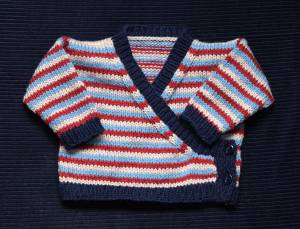
The crossover front is another practical detail. Two visible buttons are combined with hidden press-stud fastenings inside, helping the wrap front stay securely in place. The original sample is striped, although the written pattern is designed for a main color with contrasting edging.
Quick Pattern Information
- Yarn weight: DK
- Yarn: Rowan Milk Cotton
- Needles: 3.5 mm and 4 mm circular needles
- Skill level: Enthusiast
- Sizes: 0–3, 3–6, 6–12 and 12–18 months
- Gauge: 22 stitches and 30 rows = 10 cm in stockinette stitch
- Construction: Body knitted in one piece; sleeves picked up and knitted onto the armholes
- Techniques: Stockinette stitch, 1×1 rib, intarsia, magic loop, picking up stitches, buttonholes and three-needle cast-off
- Fastening: Two buttons and two hidden press studs
- Get the free pattern: Baby Wrap-Cardigan by It’s a Stitch Up
🧶 Yarn pick: The original cardigan uses DK-weight cotton, chosen because it is easy to care for, but the designer specifically created a seam-free construction to avoid the stiffness cotton can sometimes develop around sewn seams. If substituting the discontinued Rowan Milk Cotton, concentrate on achieving the pattern’s 22-stitch gauge with a soft, washable DK yarn. A cotton blend can preserve the smooth, lightweight character of the original while adding a little more elasticity than pure cotton. For a baby garment, softness and easy washing are particularly useful qualities.
Materials Used in This Pattern
Yarn
| Yarn | Color | 0–3 months | 3–6 months | 6–12 months | 12–18 months |
|---|---|---|---|---|---|
| Rowan Milk Cotton | Main color | 2 × 50 g | 3 × 50 g | 3 × 50 g | 3 × 50 g |
| Rowan Milk Cotton | Contrast color | 1 × 50 g | 1 × 50 g | 1 × 50 g | 1 × 50 g |
Needles and Notions
| Material | Details |
|---|---|
| Circular needle | 3.5 mm |
| Circular needle | 4 mm |
| Extra needle | 4 mm needle for three-needle cast-off |
| Stitch holders | 3, or use scrap yarn |
| Removable stitch markers | 2 |
| Buttons | 2 × 1 cm buttons |
| Press studs | 2 small press studs |
Four Baby Sizes From 0 to 18 Months
The pattern provides four sizes covering approximately newborn to 18 months, with both body and finished garment measurements supplied.
| Size | 0–3 months | 3–6 months | 6–12 months | 12–18 months |
|---|---|---|---|---|
| Chest circumference | 36 cm | 41 cm | 46 cm | 48 cm |
| Garment width | 24 cm | 27 cm | 29 cm | 30 cm |
| Garment length | 23 cm | 25 cm | 27 cm | 28 cm |
| Sleeve length | 14 cm | 16.5 cm | 19 cm | 22 cm |
The designer notes that the proportions were adjusted after feedback from parents and recommends choosing the size according to the baby’s actual body circumference rather than relying solely on age.
There is also a point in the pattern where the cardigan length can be adjusted by adding or removing rows, which is useful when knitting for a baby whose proportions don’t quite correspond to the standard age sizing.
A One-Piece Baby Cardigan With Minimal Seaming
The construction is probably the most interesting feature of this pattern.
Rather than knitting separate back and front pieces and sewing everything together, the body begins as one continuous piece. The fronts are shaped to create the overlapping wrap design before the upper sections are worked separately.
The shoulder sections are then joined using a three-needle cast-off.
This creates a flatter shoulder join than conventional sewing and fits with the designer’s original aim of reducing potentially stiff seams in a cotton baby garment.
If you particularly like this style of construction, Knitting Bee has a collection of free one-piece baby cardigan knitting patterns featuring several different approaches to seamless and minimal-seam baby garments.
The Sleeves Are Knitted Directly Onto the Cardigan
There are no separate sleeves to sew into the armholes.
Instead, stitches are picked up around each armhole and the sleeves are knitted in the round using magic loop. Double-pointed needles could also be used if that is your preferred method for small circumferences.
The sleeves gradually decrease towards the cuffs before finishing with contrasting 1×1 ribbing.
For a small baby garment, eliminating bulky armhole seams is particularly useful and also reduces the amount of sewing required once the knitting is finished.
The Wrap Front Is Practical for Babies
The crossover shape isn’t purely decorative.
Wrap-style baby clothes can be easier to put on and take off because they don’t need to be pulled over the baby’s head. That practicality was part of the designer’s original thinking when creating the cardigan.
The outer closure uses two buttons, while two small press studs are hidden inside the overlapping front. The internal fastening helps hold the underneath layer securely without adding another visible design element to the front.
Contrast Edging Without Complicated Colorwork
Although photographs of the original cardigan show stripes, the written instructions are actually for a single main color with contrasting edging.
The contrast appears around the lower edge, front opening and cuffs.
Basic intarsia technique is used where the main and contrast colors meet along the front edge. The yarns are crossed at the color change to prevent a gap from forming.
This gives you the visual interest of a two-color cardigan without requiring stranded colorwork across the entire garment.
You could keep the contrast subtle with two related shades or make the edging much more obvious by combining a neutral body with a stronger contrasting color.
What Happened to Rowan Milk Cotton?
The original pattern specifies Rowan Milk Cotton, with 50 g balls used for both the main and contrast colors.
For an older free knitting pattern like this, finding the exact original yarn isn’t necessary. The more important specification is the DK weight and gauge of 22 stitches and 30 rows over 10 cm in stockinette stitch.
When substituting yarn, knit a gauge swatch before starting. This is especially important for a baby cardigan because even a relatively small difference in stitch gauge can noticeably alter the finished chest measurement.
A machine-washable DK yarn is also worth considering for something likely to need frequent washing.
Is This Baby Cardigan Suitable for Beginners?
The designer classifies the pattern as Enthusiast, and there are several techniques that move it beyond a very basic first cardigan.
You will need to be comfortable with shaping, picking up stitches and working small circumferences in the round. The pattern also introduces three-needle cast-off and simple intarsia.
None of those techniques is particularly elaborate on its own, however, and the cardigan mainly uses familiar stockinette and 1×1 rib.
It could therefore be an interesting progression project for a knitter who has already completed simpler baby garments and wants to learn some new construction techniques.
For easier options, browse 45+ free baby cardigan knitting patterns, which includes a dedicated selection of easy and beginner-friendly designs.
More Free Baby Cardigan Knitting Patterns
Knitting Bee has a large collection of 190+ free baby cardigan knitting patterns, covering everything from simple garter stitch jackets to lace, cables, seamless designs and more traditional baby cardigans.
For another crossover construction, see the Baby Wrap Cardigan with Textured Stitches. It takes the wrap-cardigan idea in a very different direction, combining the crossover front with cables, bobbles and other textured stitches.
FAQs About the Baby Wrap Cardigan
What sizes does the Baby Wrap Cardigan pattern include?
The pattern includes four sizes: 0–3 months, 3–6 months, 6–12 months and 12–18 months.
What yarn weight does the pattern use?
It uses DK-weight yarn. The original cardigan was knitted with Rowan Milk Cotton.
How much yarn do I need?
Depending on size, the pattern requires two or three 50 g balls of the main color plus one 50 g ball of the contrast color.
What is the gauge?
The specified gauge is 22 stitches and 30 rows over 10 cm in stockinette stitch.
Is the cardigan seamless?
It is designed to minimize conventional seams. The body is knitted in one piece, the sleeves are picked up and knitted directly onto the armholes, and the shoulders are joined using a three-needle cast-off.
Are the sleeves knitted flat?
No. The sleeves are worked in the round after stitches are picked up around the armholes. The designer uses the magic-loop technique but notes that double-pointed needles can also be used.
Does the pattern include the striped version shown in the photographs?
The sample cardigan is striped, but the written instructions are for a single main color with contrasting edging.
How does the wrap cardigan fasten?
It uses two visible buttons together with two small hidden press studs that secure the overlapping front.
Can I substitute Rowan Milk Cotton?
Yes. Concentrate on finding a soft DK yarn that can achieve the specified gauge rather than trying to locate the exact original yarn. For a baby cardigan, an easy-care fibre is particularly practical.
Where can I find the complete knitting instructions?
The complete free pattern is available through the Get the free pattern link near the top of this page.