Looking for a free tea cosy knitting pattern? This collection brings together more than 30 free patterns for knitted tea cosies, from very easy garter-stitch designs to cables, flowers, Fair Isle, brioche and novelty cosies.
But choosing a tea cosy pattern isn’t only about finding one you like the look of.
After comparing the patterns in this collection, I found considerable differences in teapot size, yarn weight, needle type, construction, insulation and finishing. Some cosies are knitted completely flat on straight needles, while others are worked in the round or switch between flat and circular knitting to create openings for the handle and spout. Some are simple one-layer cosies, while others incorporate pleats, doubled yarn, knitted linings or even wadding.
I’ve included those details wherever the original pattern provides them so you can choose a tea cosy that suits both your teapot and the way you like to knit.
Find the Right Tea Cosy Knitting Pattern
If you already know what you’re looking for, use these sections to narrow down the collection:
- Easy tea cosy knitting patterns – good starting points if you want straightforward construction and basic stitches.
- Tea cosies knitted on straight needles – ideal if you don’t want to knit the main cosy in the round.
- Flower tea cosy knitting patterns – from simple knitted flowers to elaborate botanical decorations.
- Cable and textured tea cosies – twisted stitches, smocking, cables, ribbing and other textured fabrics.
- Fair Isle and colourwork tea cosies – stripes, slip stitches, stranded knitting and steeking.
- Animal and novelty tea cosies – cats, dogs, cupcakes, cottages, beehives and more.
- Traditional tea cosy knitting patterns – classic shapes, pleats, ribs and gathered designs.
Before choosing a pattern: measure your teapot. A pattern described as fitting a “4-cup” or “6-cup” pot won’t necessarily fit every teapot of that capacity because teapots can be tall, squat, wide or narrow.
Which Tea Cosy Should I Knit?
If you don’t want to compare every pattern, these are some of the most useful starting points from the collection.
| I want to knit… | Pattern to consider | Why |
|---|---|---|
| My first tea cosy | Lily Sugar’n Cream Beginner Tea Cozy | Official Beginner pattern made from two garter-stitch squares |
| A 1-cup cosy | Flower Garden Tea Cosy | Specifically includes a 1-cup size |
| A 2-cup cosy | Cosy Cables | Specifically designed for a standard 2-cup pot |
| A 4-cup cosy | Brewed in Brioche | Designed for a standard 4-cup pot |
| A 6-cup cosy | Flower Basket Tea Cozy | Specifically designed for a 6-cup teapot |
| A large tea cosy | Daisy Bush | Designed for a large 7-cup/1.75-litre pot |
| Something on straight needles | Lily Sugar’n Cream Beginner Tea Cozy | Main cosy is completely flat with no circular knitting |
| My first circular tea cosy | Seeded Columns | Official Beginner pattern that introduces knitting in the round |
| A simple cable-like texture | Twisted Stitch Tea Cosy | Tw2R produces a twisted effect without a cable needle |
| Proper cable practice | Cosy Cables | Diamond cables in a relatively small 2-cup project |
| An elaborate cable project | Patons Aran Sweater Tea Cozy | Multiple cables, chart reading, buttonholes and picked-up ribbing |
| Simple stranded colourwork | Cascade Fair Isle Tea Cozy | Repeating stranded pattern worked in the round |
| A steeking project | Wee County Yarns Fair Isle Tea Cosy | In-the-round Fair Isle followed by reinforced and cut steeks |
| A brioche project | Brewed in Brioche | Two-colour brioche worked both flat and in the round |
| Extra insulating construction | Daisy Bush | Separate knitted outer and inner layers |
| A cosy for an unusual teapot | Bodum Tea Cozy | Adaptable recipe fitted directly to the actual pot |
| Lots of floral detail | Spring Flower Tea Cosy | Daffodils, crocuses and leaves make this one of the most decorative |
| A novelty design | Patons Beehive Tea Cozy | Structural pleats transform the knitted fabric into a beehive |
These aren’t necessarily the “best” patterns overall. They’re the patterns that stand out for a particular size, construction method or knitting technique.
Easy Knitting Patterns for Tea Cozies
A tea cosy can be a very manageable first homewares project because it is small and doesn’t need to fit a human body.
For the easiest patterns, look for flat construction, garter stitch or simple ribbing, minimal shaping and relatively little finishing.
The Lily Sugar’n Cream Beginner Tea Cozy is the simplest benchmark in this collection: two garter-stitch squares are knitted and sewn together before the top is gathered. Seeded Columns is more interesting if you already know the basics and want an introduction to circular knitting.
Don’t assume, however, that a tea cosy that looks elaborate is necessarily difficult to knit. Some of the floral patterns have extremely simple main bodies; most of the work comes afterwards when the flowers and leaves are made and attached.
Lily Sugar’n Cream Beginner Tea Cozy
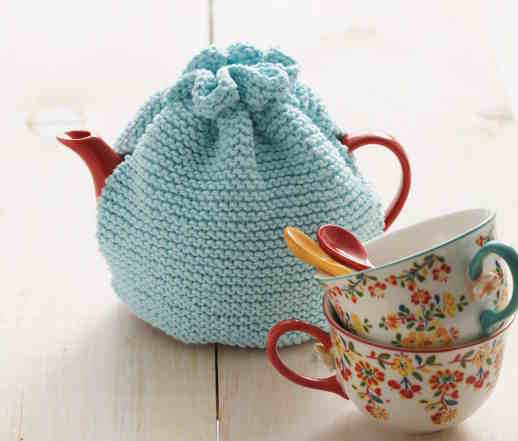
If you are looking for a very easy tea cosy knitting pattern, this is one of the simplest in the collection. The cosy is made from just two garter-stitch squares, so there is no shaping and no need to knit in the round.
The two squares are sewn together at the sides, leaving openings for the teapot handle and spout. A running stitch is then worked around the top and pulled tight to gather the cosy.
Pattern details
- Difficulty: Beginner
- Free: Yes
- Format: Free downloadable PDF
- Teapot size: 4-cup teapot
- Yarn: Lily Sugar’n Cream cotton
- Yarn weight: Worsted / medium weight
- Needles: 4.5mm (US 7) knitting needles
- Construction: Knitted flat in two identical squares
- Stitch pattern: Garter stitch
- Gauge: 19 stitches and 32 rows = 10cm / 4 inches in garter stitch
- Techniques: Cast on, knit stitch, cast off, flat seaming and running stitch
- Finishing: The two squares are seamed together, leaving openings for the handle and spout; the top is gathered with a running stitch.
- Best for: Complete beginners, straight-needle knitters and anyone wanting a very simple first tea cosy.
What makes this pattern different:
This is about as straightforward as tea-cosy construction gets. There are no purl stitches, increases, decreases, cables or colourwork in the main cosy. The PDF even includes illustrated instructions for casting on, the knit stitch, casting off, weaving in ends and making the flat seam, making it particularly suitable for someone still learning to knit.
Get the free Lily Sugar’n Cream Tea Cozy PDF
Holiday Teapot Cozy by Edie Eckman
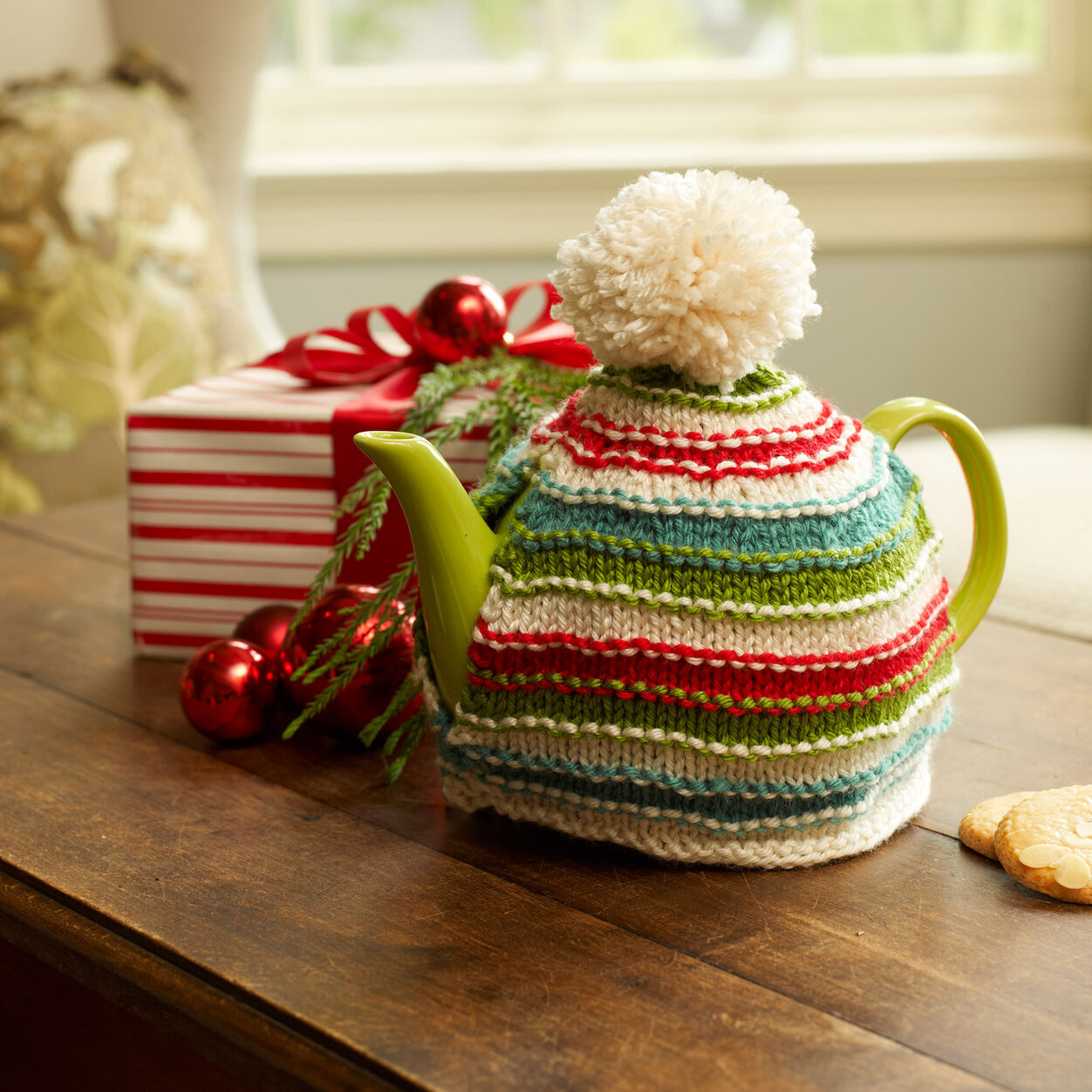
Designed by Edie Eckman for Red Heart, this colourful striped tea cosy is an easy, straight-needle pattern that can be adjusted to fit your own teapot. The pattern provides two sizes, but also specifically instructs you to try the cosy on the pot as you knit so you can adjust the positioning of the handle and spout openings.
The cosy is knitted flat as two matching pieces, using simple garter and stocking-stitch sections with four-row colour changes. Decreases shape the top, which is gathered closed and finished with a pom-pom.
Pattern details
- Designer: Edie Eckman
- Difficulty: Easy
- Free: Yes
- Format: Free downloadable PDF
- Sizes: Small and medium
- Finished circumference: 46cm (18in) or 51cm (20in) at the widest point
- Teapot capacity: Not stated; designed to fit most teapots and customizable to the individual pot
- Yarn: Red Heart Soft
- Yarn weight: Medium / worsted
- Needles: 5mm (US 8) knitting needles
- Construction: Knitted flat in two matching pieces
- Stitch patterns: Garter stitch and stocking stitch
- Colourwork: Four-colour stripes
- Techniques: Knit, purl, simple colour changes, k2tog decreases, shaping, gathering and seaming
- Gauge: 16 stitches and 23 rows = 10cm / 4 inches in stocking stitch
- Finishing: The two sides are seamed above and below the handle and spout openings; remaining top stitches are gathered closed and a pom-pom is attached
- Best for: Beginners, straight-needle knitters, simple colourwork and teapots that don’t correspond neatly to a standard cup size.
What makes this pattern different:
Adjustable fit is the real advantage of this pattern. Rather than assuming that every teapot of a particular capacity has the same proportions, the designer tells you to try the cosy on the actual teapot while knitting and adjust where the handle and spout openings are placed. That makes it an especially useful choice for unusually shaped pots.
Get the free Holiday Teapot Cozy PDF
Seeded Columns Tea Cosy
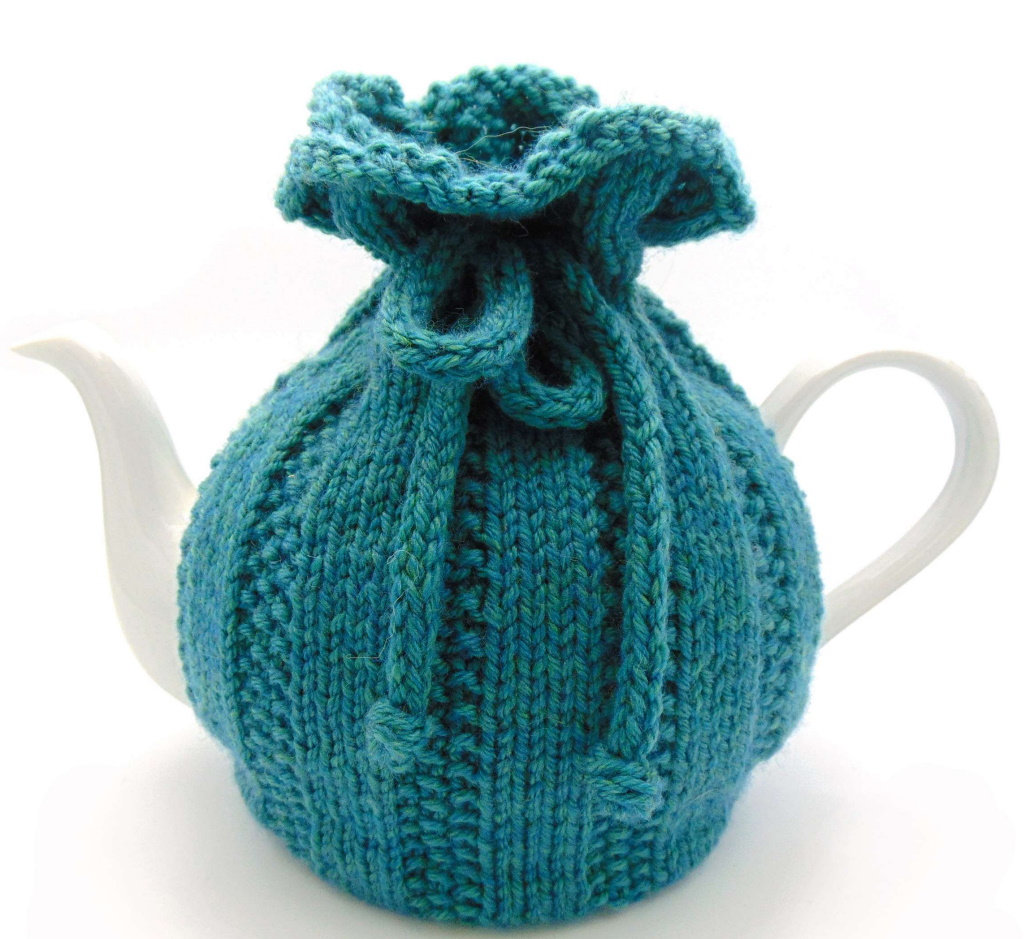
Designed by Trish Campbell for Estelle Yarns, the Seeded Columns Tea Cosy uses a simple two-round textured rib pattern to create vertical columns across the fabric. It is designed for a standard 6-cup teapot and is officially rated Beginner.
The cosy starts in the round, divides into two sections that are worked flat to create the handle and spout openings, and is then rejoined in the round for the top. An I-cord drawstring threaded through an eyelet round pulls the upper edge snugly around the teapot.
Pattern details
- Designer: Trish Campbell
- Difficulty: Beginner
- Free: Yes
- Format: Free downloadable PDF
- Teapot size: Standard 6-cup teapot
- Finished width: 16in / approximately 40.5cm
- Finished height: 9in / approximately 23cm
- Yarn: Estelle Worsted Heather or Estelle Worsted
- Yarn weight: Worsted
- Fibre: 50% acrylic, 40% wool, 10% nylon
- Main needle: 4.5mm (US 7), 40cm / 16in circular needle
- Additional needles: 4mm (US 6) DPNs for the I-cord drawstring
- Construction: Begins in the round, divides into two flat sections for the handle and spout openings, then rejoins in the round
- Main stitch pattern: Two-round seed-stitch rib / textured column pattern
- Techniques: Knit, purl, knitting in the round, knitting flat, backward-loop cast-on, yarn over, k2tog, joining in the round, eyelets and I-cord
- Gauge: 20 stitches and 30 rows = 10cm / 4in in seed-stitch ribbing
- Handle and spout openings: Each side is worked separately until the opening measures 4.5in / approximately 11.5cm
- Top: Eyelet round with an I-cord drawstring
- I-cord: Approximately 20in / 51cm long
- Finishing: Relatively light – small plackets around the openings are stitched to the inside, ends are woven in and the I-cord is threaded through the eyelets
- Best for: Beginners wanting to try circular knitting, 6-cup teapots, textured knitting and knitters who prefer an adjustable drawstring top.
What makes this pattern different:
The most useful feature of this pattern is the way it introduces both circular and flat knitting within a relatively simple Beginner project.
The first section is knitted in the round. When the cosy reaches the handle and spout, the 70 stitches are divided into two groups of 35. Each half is then worked back and forth separately until the openings measure 4.5in. The two halves are subsequently returned to the circular needle and joined so the upper section can once again be knitted in the round.
That makes the construction easier to understand than some of the more elaborate hybrid tea cosies: round → flat → round.
The top is different from the many tea cosies that finish with decreasing and gathering. An eyelet round is worked instead, followed by another section of textured knitting. A separate 3-stitch I-cord drawstring is threaded through the eyelets and tied in a bow, allowing the top to be pulled snugly around the teapot.
For a knitter who has mastered basic knit and purl stitches but wants to move beyond completely flat projects, this is one of the more approachable circular-knitting options in the collection because the designer specifically rates it Beginner.
Get the free Seeded Columns Tea Cosy PDF
Lily Sugar’n Cream Tea Cozy and Egg Cozy
This classic striped tea cosy is knitted flat in two matching pieces using a combination of seed stitch and stocking stitch. It is specifically designed to fit a 6-cup teapot, making it one of the more useful patterns in this collection if you need a cosy for a larger pot.
The main fabric is predominantly seed stitch, with narrow contrasting stocking-stitch stripes adding colour. Simple decreases shape the top before the remaining stitches are gathered together. There’s also a matching knitted egg cosy included in the pattern.
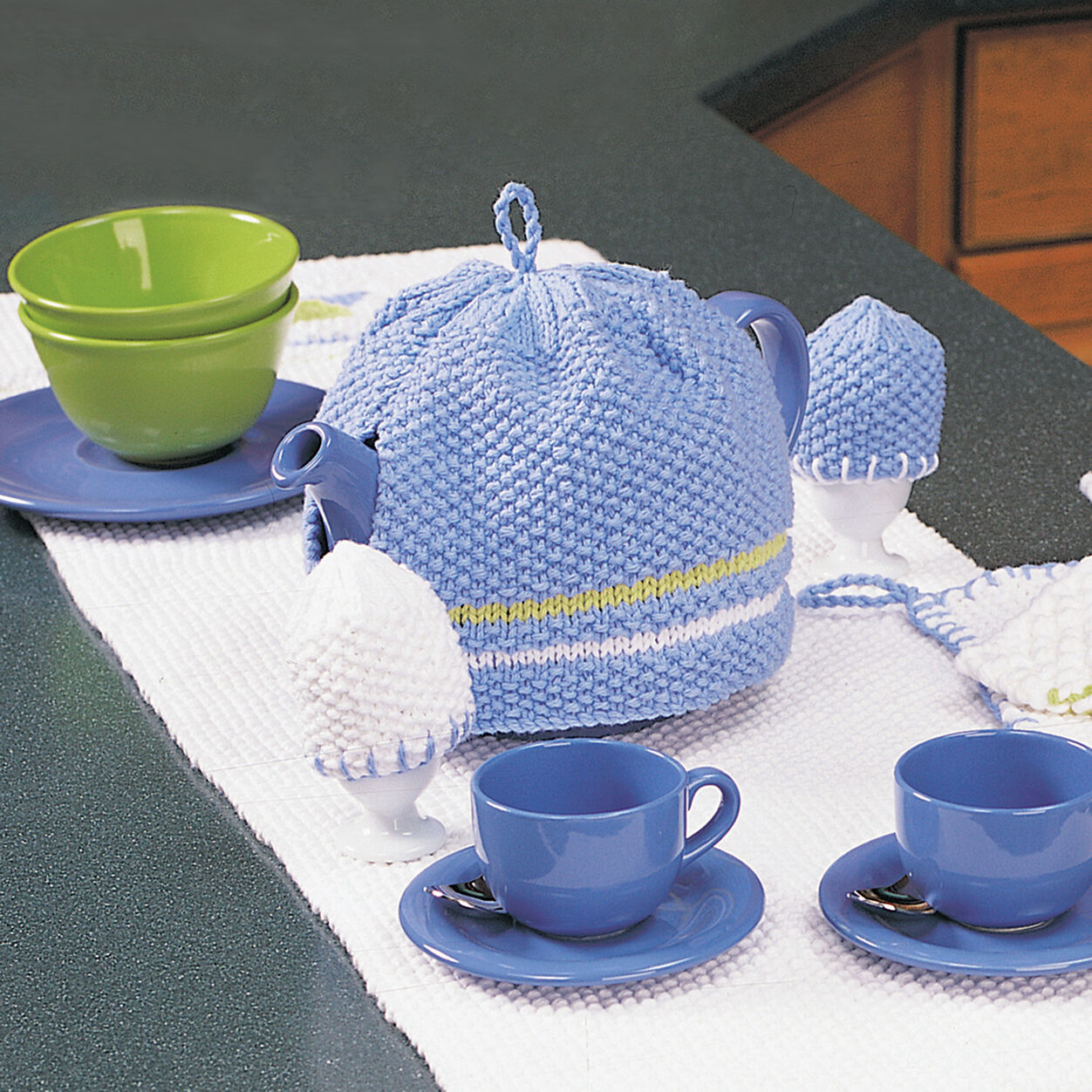
Pattern details
- Free: Yes
- Format: Free downloadable PDF
- Teapot size: 6 cup
- Yarn: Lily Sugar’n Cream
- Yarn weight: Worsted / medium weight cotton
- Needles: 4.5mm (US 7) knitting needles
- Construction: Knitted flat in two matching pieces
- Stitch patterns: Seed stitch and stocking stitch
- Colourwork: Simple horizontal stripes using three colours
- Techniques: Knit, purl, seed stitch, stocking stitch, colour changes, k2tog decreases, gathering and seaming
- Gauge: 20 stitches and 26 rows = 10cm / 4 inches in stocking stitch
- Finishing: Side and top seams are sewn while leaving openings for the handle and spout; a twisted-cord loop is attached at the top
- Difficulty: Not stated in the supplied pattern
- Extra: Includes instructions for a matching egg cosy
- Best for: Straight-needle knitters, 6-cup teapots and knitters wanting an approachable textured pattern with simple colour changes.
What makes this pattern different:
The combination of seed stitch and contrasting stocking-stitch stripes gives this cosy plenty of texture without requiring cables or stranded colourwork. It is also one of the patterns in this collection that explicitly states its teapot capacity, so it is particularly useful when choosing a pattern for a 6-cup teapot.
Get the free Lily Sugar’n Cream Tea Cozy and Egg Cozy PDF
Tea Cosy Knitting Patterns on Straight Needles
If you prefer knitting flat, there are plenty of tea cosy patterns that don’t require the main body to be knitted in the round.
Some of the best straight-needle choices in this collection include the Lily Sugar’n Cream Beginner Tea Cozy, Classic Pleated Tea Cozy, Holiday Teapot Cozy, Twisted Stitch Tea Cosy, Cushy Smocked Tea Cozy, Flower Basket Tea Cozy, Fairy Cake Tea Cosy and Union Jack Tea Cosy.
There is an important distinction between completely straight-needle patterns and patterns where the main cosy is knitted flat but DPNs are used for a small finishing detail.
For example, Blighty is predominantly a straight-needle tea cosy, but DPNs are used to make its decorative I-cord. Fresh as a Daisy similarly uses straight needles for the main cosy but DPNs for its I-cord.
If avoiding circular needles is important to you, check the “Needles” and “Construction” information under each pattern rather than assuming that “knitted flat” means no DPNs are required anywhere in the project.
Knitted Tea Cozy for a Bodum Teapot
This unusual tea cosy was designed specifically for a small Bodum teapot holding approximately two mugs of tea. Rather than the traditional round teapot shape used for many tea cosy patterns, this Bodum model has a removable glass bowl sitting inside a plastic holder, and the cosy’s construction takes advantage of that design.
The cosy itself is surprisingly simple: essentially a large ribbed rectangle with openings for the handle, a partially sewn opening for the spout and a drawstring that gathers the top.
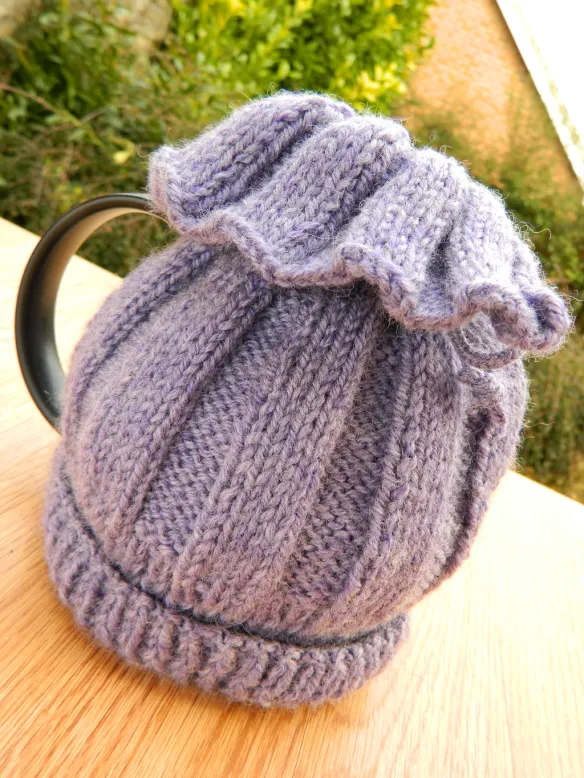
Pattern details
- Designer: Snottydog
- Free: Yes
- Format: Free blog instructions / adaptable recipe rather than a formal row-by-row pattern
- Teapot size: Small Bodum teapot holding approximately two mugs
- Finished dimensions: Not stated
- Yarn: Designer believes the yarn used was DK
- Yarn weight: Probably DK, but not confirmed
- Needles: UK size 8 needles (approximately 4mm)
- Cast on: 100 stitches
- Construction: One large rectangle
- Lower stitch pattern: K1, P1 rib
- Main stitch pattern: K5, P5 rib
- Handle openings: Buttonhole-style openings made by casting off stitches and casting them back on the following row
- Spout opening: Created by partially seaming the front
- Top: Drawstring threaded through a row of small buttonhole eyelets
- Original drawstring: Lucet-braided cord
- Alternative drawstring: Crochet chain or contrasting cord
- Techniques: Knit, purl, ribbing, casting off and casting stitches back on, buttonhole-style openings, seaming and making eyelets
- Difficulty: Not formally stated; the designer describes the cosy as very basic and easy to make
- Best for: Small Bodum teapots, approximately two-mug pots, rib knitting and knitters comfortable adapting a simple design to their own teapot.
What makes this pattern different:
This is one of the clearest examples in the collection of why teapot shape matters just as much as capacity.
The cosy was designed around a Bodum teapot with a removable glass bowl and separate plastic holder. Because the glass section can be unclipped, the cosy can have two buttonhole-style openings through which the handle is threaded before the glass bowl is put back into position.
The construction is also unusually simple. The designer cast on 100 stitches and essentially created one large ribbed rectangle, using K1, P1 rib at the bottom and K5, P5 rib for the main body.
At the top, a series of small buttonhole eyelets accommodates a drawstring. Pulling the cord gathers the wide ribbed fabric around the top of the pot. The cosy can then be opened up when the pot needs filling and pulled closed again afterwards.
There is an important caveat with this pattern: it is better thought of as an adaptable knitting recipe than a precise pattern. The designer explains that she estimated the size and periodically held the knitting against her teapot while making it.
That makes it particularly interesting for someone with an unusually shaped teapot who is comfortable adjusting a simple design to fit, but less suitable for a beginner who wants exact row-by-row instructions.
Get the free Bodum Teapot Tea Cosy instructions
Garter Stitch Tea Cosy with Decorative Edging
This traditional tea cosy is knitted entirely flat on straight needles, with two matching pieces sewn together around the teapot.
Although the main fabric is garter stitch, it is more interesting than a basic rectangular cosy. Short rows are worked repeatedly across 26 of the 34 stitches, helping shape the fabric, while occasional eyelets add detail. A separate knitted edging is attached around the top and finished with a twisted cord threaded through the eyelets to gather the centre.
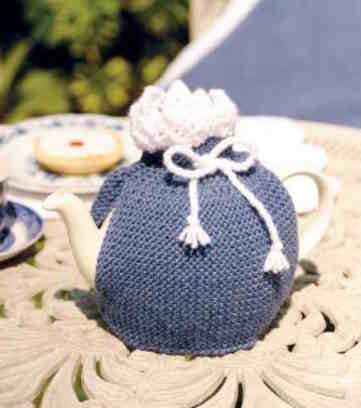
Pattern details
- Free: Yes
- Format: Free pattern
- Needles: 4.5mm straight needles
- Construction: Knitted flat in two matching pieces
- Main stitch: Garter stitch
- Techniques: Short rows, yarn forwards, k2tog, eyelets and simple shaping
- Finishing: Two pieces are seamed while leaving openings for the handle and spout; a separately knitted edging is attached around the top.
- Top closure: Twisted cord threaded through the eyelets and tied at the centre
- Colours: Two yarn colours – one for the main cosy and a contrasting colour for the edging
- Difficulty: Not stated in the supplied pattern
- Teapot size: Not stated in the supplied instructions
- Yarn weight: Not stated in the supplied instructions
- Best for: Straight-needle knitters who want an easy-looking traditional cosy with a little more technique than a basic two-rectangle pattern.
What makes this pattern different:
The repeated short-row sections create shaping without requiring circular knitting or complicated decreases. The separately knitted eyelet edging and twisted-cord closure also give it a more decorative finish than a basic garter-stitch tea cosy.
Get The Garter Stitch Tea Cosy
Blooming Teapot Cozy
The Blooming Teapot Cozy from Lion Brand combines a stretchy ribbed tea cosy with seven colourful spiral flowers and six knitted leaves. Lion Brand rates the pattern Easy, although there is more finishing involved than with many of the other easy patterns in this collection.
The main cosy is worked completely flat as two matching pieces. It combines 2×2 ribbing with Garter Rib, producing an elastic fabric designed to stretch around the teapot. The flowers and leaves are knitted separately and sewn across the gathered top.
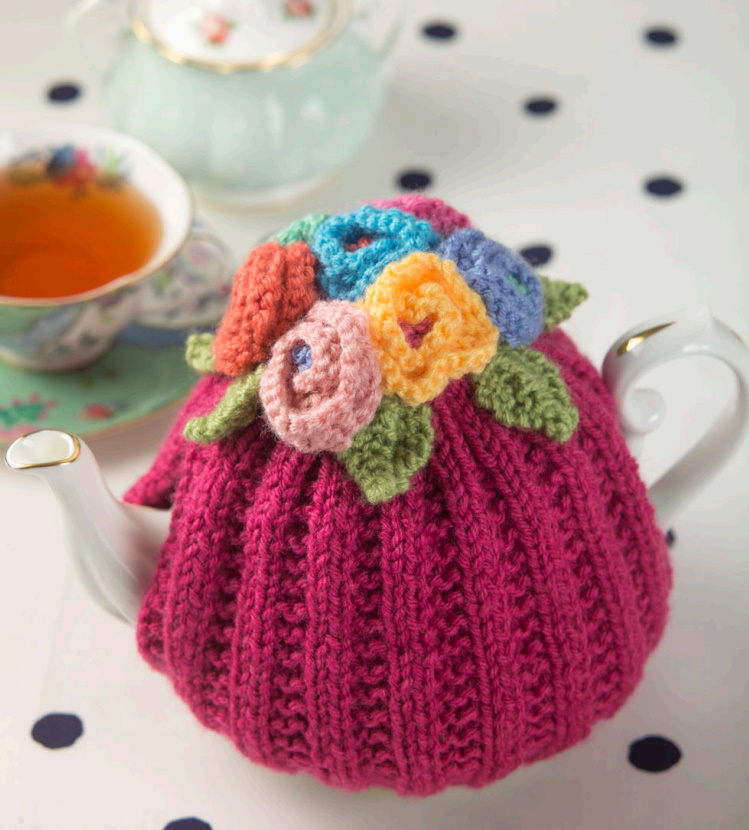
Pattern details
- Difficulty: Easy
- Free: Yes
- Format: Free downloadable PDF
- Finished circumference: Approximately 38cm (15in), designed to stretch to fit most teapots
- Finished height: Approximately 18cm (7in)
- Teapot capacity: Not stated
- Main yarn: Lion Brand Vanna’s Choice
- Yarn weight: Medium / worsted
- Flower and leaf yarn: Lion Brand Vanna’s Palettes
- Needles: 5mm (US 8) for the cosy; 3.75mm (US 5) for flowers and leaves
- Construction: Knitted flat in two matching pieces
- Main stitch patterns: 2×2 rib and Garter Rib
- Techniques: Knit, purl, ribbing, p2tog, k2tog, kfb, M1 increases, sk2p double decreases, shaping and gathering
- Gauge: 20 stitches and 26 rows = approximately 10cm / 4 inches in Garter Rib
- Flowers: Seven separately knitted spiral flowers
- Leaves: Six separately knitted leaves
- Decorative finishing: French knots are embroidered into the centres of the flowers
- Finishing: The two main pieces are partially seamed on each side, leaving 9cm openings for the teapot handle and spout; flowers and leaves are then attached to the gathered top
- Best for: Easy textured knitting, straight-needle knitters and anyone wanting a floral tea cosy without complicated knitting in the main body.
What makes this pattern different:
The cosy is deliberately designed around stretch rather than a specific teapot capacity. Its 38cm circumference is intended to expand to fit most teapots, with the combination of 2×2 rib and Garter Rib creating an elastic fabric.
The flowers are also constructed in an interestingly simple way. Each begins with only six stitches and is rapidly increased to 48 stitches using kfb increases, then twisted into a spiral and secured into a flower shape.
Get the free Blooming Teapot Cozy PDF
Cottage Tea Cosy with Wadded Lining
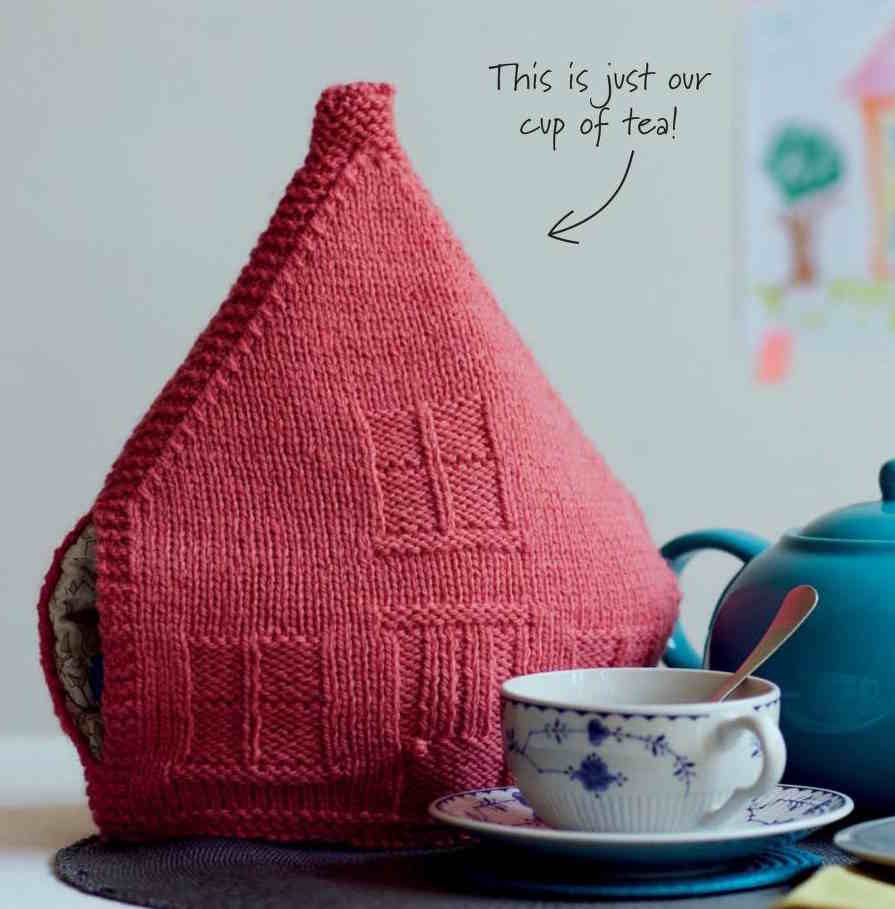
This cottage-style tea cosy is knitted in DK wool on straight needles, with the front worked in an extensive knit-and-purl pattern to create the architectural details of the house. The back is considerably simpler, making the decorative front the focus of the design.
More importantly from a practical point of view, the pattern includes a separate fabric lining backed with wadding, giving us one of the clearest examples in this collection of a tea cosy specifically constructed with an insulating layer.
Pattern details
- Format: Written pattern
- Teapot size: 1-litre teapot
- Finished size: Approximately 25 x 29cm
- Yarn: Erika Knight for John Lewis DK
- Yarn weight: DK
- Fibre: 100% wool
- Yarn amount: 2 x 50g balls
- Needles: 4mm straight knitting needles
- Additional materials: 0.5m wadding and 0.5m lining fabric
- Construction: Separate front and back knitted flat
- Front: Detailed knit-and-purl cottage motif
- Back: Predominantly stocking stitch with garter-stitch borders
- Techniques: Knit, purl, k2tog, k2tog through the back loop, k3tog, shaping, seaming and simple embroidery
- Gauge: The supplied text appears corrupted/incomplete, so I would not publish a gauge figure without checking the original
- Handle and spout openings: Gaps are left when the knitted front and back are joined
- Lining: Separate fabric lining with a layer of wadding
- Embroidery: Optional French-knot doorknob
- Finishing: High – includes knitted seaming, constructing the wadded fabric lining and hand-stitching the lining into the cosy
- Difficulty: Not stated in the supplied pattern
- Best for: 1-litre teapots, straight-needle knitting, pictorial knit-and-purl designs and knitters specifically looking for an insulated tea cosy.
What makes this pattern different:
The standout feature here isn’t simply the cottage design – it’s the wadded lining.
After the knitting is completed, the back piece is used as a template for creating the lining. Two pieces are cut from lining fabric and another two from wadding, with a 1cm seam allowance added around the template.
The wadding is attached to the wrong side of the lining pieces before the lining is assembled and inserted inside the knitted shell. It is then slip-stitched into position around the lower edge and the handle and spout openings.
This gives the finished cosy three functional components: the knitted wool exterior, wadding and fabric lining. That’s substantially different construction from an ordinary single-layer knitted tea cosy.
The cottage itself is also incorporated largely into the knitting rather than being made from numerous appliqués. The front uses carefully positioned knit and purl stitches to create the pictorial design, with just a small optional French knot used for the doorknob.
The pattern is also helpful for sizing because it gives both an intended capacity – 1 litre – and finished dimensions of approximately 25 x 29cm, rather than relying only on a vague description such as “average teapot.”
Cottage Tea Cosy with Wadded Lining Pattern
Lily Sugar’n Cream Twisted Stitch Tea Cosy
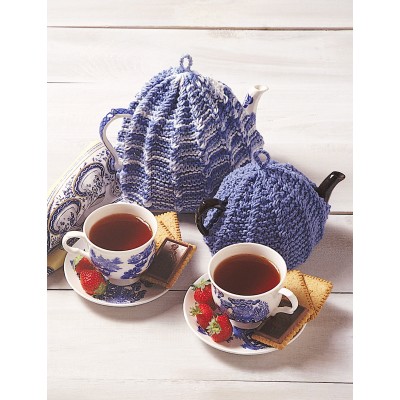
This textured cotton tea cosy comes in two useful sizes: one for an average 2-cup teapot and another for an average 6-cup teapot.
It is knitted flat as two matching pieces on straight needles. The texture is created using a right-twist stitch (Tw2R), where the second stitch is knitted before the first. This creates a small cable-like twisted effect without using a cable needle.
Pattern details
- Free: Yes
- Format: Free pattern on Knitting Bee
- Teapot sizes: Small – average 2 cup; Large – average 6 cup
- Yarn: Lily Sugar’n Cream
- Yarn weight: Worsted / medium weight cotton
- Needles: 4.5mm (US 7) knitting needles
- Additional tool: 3.75mm (US F/5) crochet hook for the top tab
- Construction: Knitted flat in two matching pieces
- Main technique: Tw2R right-twist stitch
- Techniques: Knit, purl, Tw2R, k2tog, p2tog, decreasing, gathering and seaming
- Gauge: 19 stitches and 32 rows = 10cm / 4 inches in pattern
- Finishing: The two pieces are partially seamed at the top and bottom, leaving the centre openings for the handle and spout; remaining top stitches are gathered
- Top detail: A simple 12-chain crocheted loop is attached at the top
- Difficulty: Not stated in the supplied pattern
- Best for: Straight-needle knitters, 2- or 6-cup teapots and knitters wanting to try a simple cable-like twisted stitch without a cable needle.
What makes this pattern different:
The Tw2R stitch creates a cable-like texture without requiring a cable needle, making this an interesting stepping stone between basic knit-and-purl tea cosies and more involved cable patterns. Having separate instructions for both 2-cup and 6-cup teapots also makes it particularly useful when choosing a cosy by pot size.
Get the free Twisted Stitch Tea Cosy pattern on Knitting Bee
Tea Cosy Patterns by Teapot Size
One of the most frustrating things about tea cosy patterns is inconsistent sizing.
Some designers give cup capacity. Others give circumference and height. Some specify litres, while others simply say that the pattern fits an “average teapot.”
Where the original designer provides measurements, I’ve retained them in the individual pattern information above.
For a small pot, look at:
1-cup: Flower Garden Tea Cosy and Flower Pot Tea Cosy.
2-cup: Cosy Cables and the small Lily Sugar’n Cream Twisted Stitch Tea Cosy.
Approximately two mugs: the Bodum Tea Cozy was designed around a small Bodum pot rather than a conventional round teapot.
The Patons Classic Pleated Tea Cozy is particularly useful because it provides three sizes, beginning with a 2-cup version and extending through 4–6 cup and 6–8 cup sizes.
Tea Cosy Patterns for 6-Cup Teapots
There are considerably more choices for medium and larger pots.
Patterns specifically identified as fitting around six cups include the Lily Sugar’n Cream Tea Cozy and Egg Cozy, Flower Basket Tea Cozy and several of the traditional Patons designs.
Other patterns span several capacities. The Aran Sweater Tea Cozy and Blighty, for example, are designed for approximately 6–8 cups.
Why Cup Capacity Isn’t Enough
One of the clearest lessons from comparing these patterns is that two teapots with the same capacity can require very different cosies.
Sheryl’s Tea Cozy was specifically designed for an Avanti 6-cup pot that its designer describes as longer and less round than a conventional teapot. The pattern gives measurements of approximately 40cm around the base and 16cm high.
The Bodum Tea Cozy approaches the problem differently again. Instead of relying on a standard capacity, its designer repeatedly checked the knitting against the actual pot and adjusted the cosy as she went.
The Holiday Teapot Cozy also encourages knitters to try the cosy on their teapot and adjust the handle and spout openings.
My recommendation: if the pattern supplies finished measurements, compare them with your own teapot before choosing it. Use cup capacity as a useful starting point rather than a guarantee of fit.
Flower Tea Cosy Knitting Patterns
Flower tea cosies range from straightforward knitted bodies decorated with a few flowers to projects involving dozens of separately made components.
That means it helps to distinguish knitting difficulty from finishing workload.
The Blooming Teapot Cozy, for example, uses a ribbed body decorated with relatively simple spiral flowers. Rosebuds has a straightforward garter-stitch body but requires 15 rosebuds and 10 sets of leaves.
Spring Flower is considerably more elaborate, with individually constructed daffodils, crocuses and leaves. Daisy Bush combines its double-layer construction with bobbles and 21 crocheted flowers.
Flower Basket takes another approach: the knitted body itself resembles a basket and is completed with a cable handle, knitted flowers and leaves.
The Flower Tea Cosy by Sachiyo Ishii uses yet another method. Its 32 flowers are made using a flower loom rather than being knitted or crocheted.
So if you’re choosing a floral cosy, look beyond the photograph and ask how many separate pieces need to be made and attached.
Rosebuds Tea Cosy
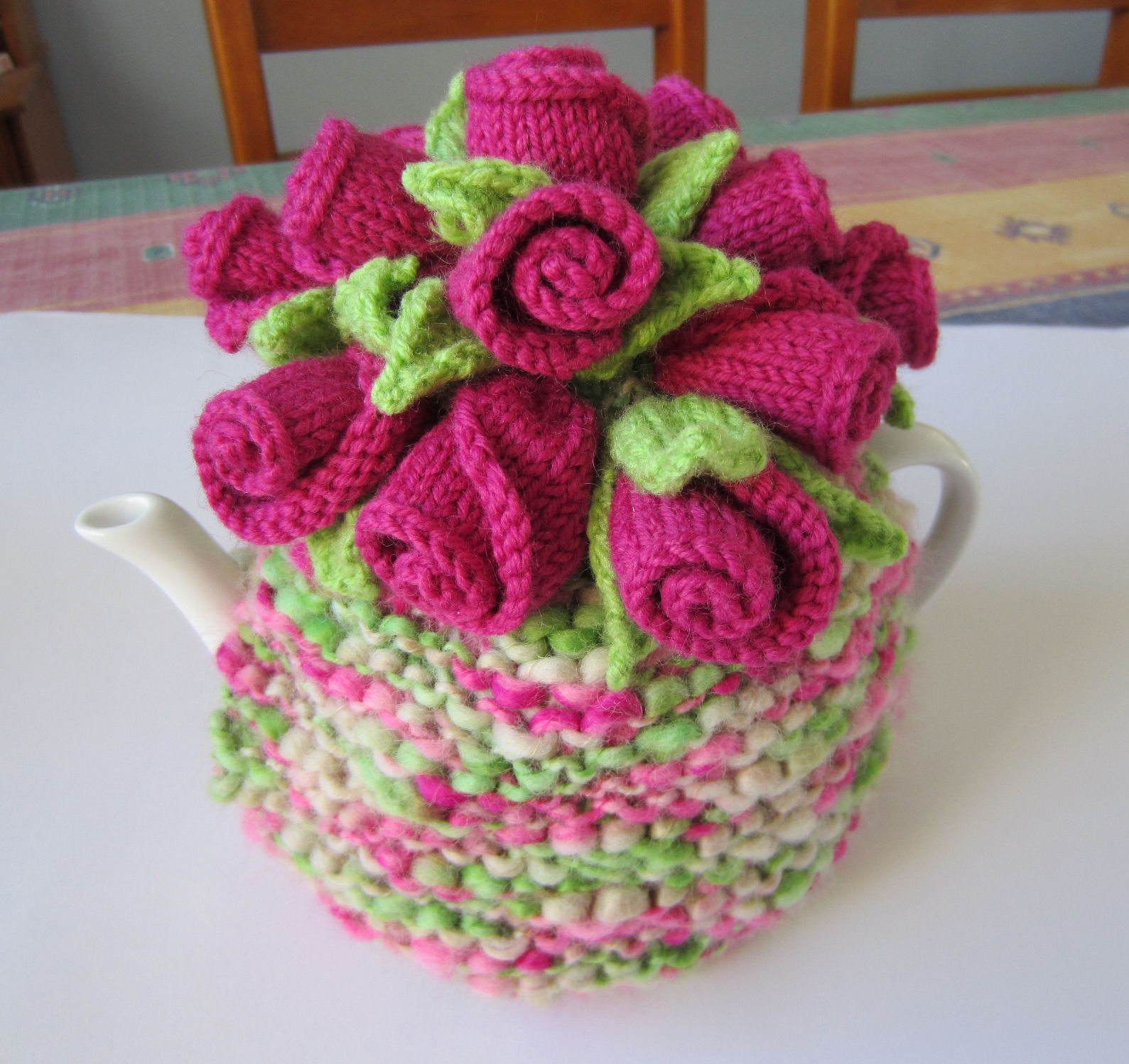
This highly decorative floral tea cosy combines a thick garter-stitch body with 15 individually knitted rosebuds. The main cosy itself is surprisingly simple: two matching pieces are knitted flat in garter stitch, with decreases shaping the top.
What makes the design much more elaborate is the finishing. The roses and leaves are knitted separately, assembled by hand and then arranged across the top of the finished cosy.
The designer deliberately knits the bulky main yarn on smaller needles than recommended on the ball band, creating a thicker, denser and stretchier fabric around the teapot.
Pattern details
- Free: Yes
- Format: Free webpage pattern
- Teapot size: 6 cup
- Teapot measurements: Approximately 44cm circumference × 18cm high
- Finished cosy: Approximately 42cm circumference × 18cm high; designed to stretch to fit
- Main yarn: Lincraft Big Wool
- Main yarn weight: Bulky, thick-and-thin wool
- Flower and leaf yarn: 8-ply / DK wool
- Needles: 6mm for the main cosy; 4mm for roses and leaves
- Construction: Knitted flat in two matching pieces
- Main stitch: Garter stitch
- Techniques: Garter stitch, k2tog decreases, stocking stitch, slipped-stitch decreases, shaping, gathering and seaming
- Gauge: Approximately 12 stitches and 26 rows = 10cm in garter stitch for the main cosy
- Flowers: 15 separately knitted rosebuds
- Leaves: 10 sets of three knitted leaves
- Finishing: Considerable – the two cosy pieces are seamed, then the individual roses and leaf sections are shaped, sewn together and attached
- Difficulty: Not stated by the designer
- Best for: 6-cup teapots, straight-needle knitters, floral tea cosies and knitters who enjoy decorative finishing.
What makes this pattern different:
The main cosy is much simpler to knit than its finished appearance suggests. Its body is essentially shaped garter stitch; most of the visual impact comes from the separately knitted roses and leaves.
The designer also deliberately uses 6mm needles with a bulky yarn whose ball band recommends 8mm, producing a tighter, denser fabric. That makes this particularly interesting if you want a substantial tea cosy rather than a loosely knitted decorative cover.
Get the free Rosebuds Tea Cosy pattern
Spring Flower Tea Cosy
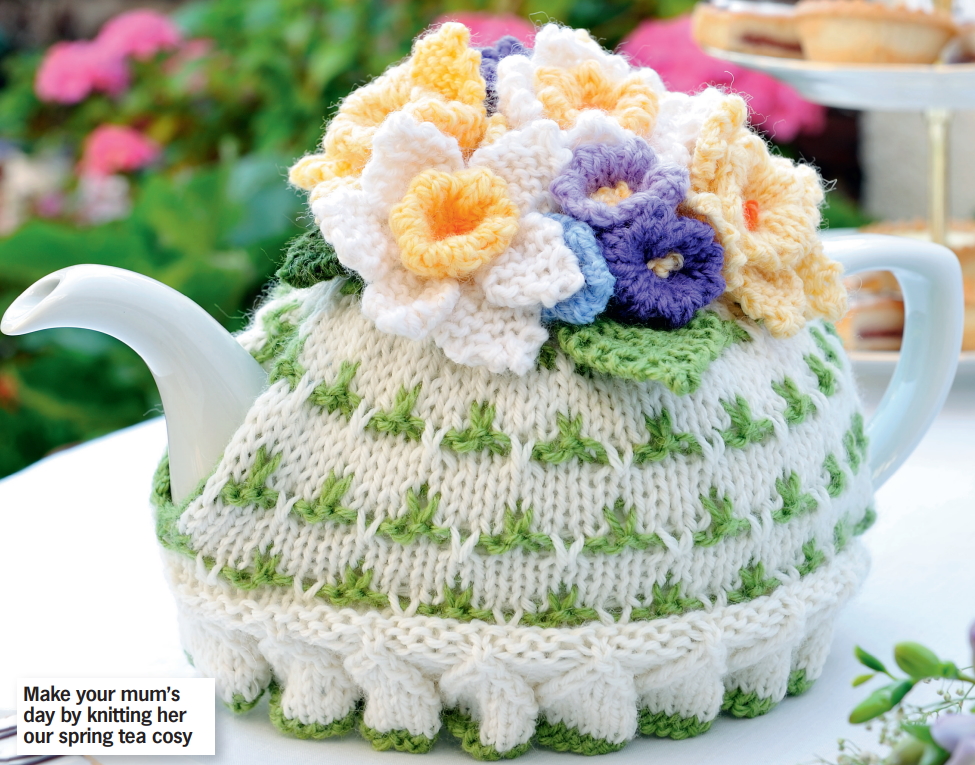
Designed by Val Pierce and originally published in Knit Today issue 38, this spring-inspired tea cosy combines a two-colour slip-stitch pattern with knitted daffodils, crocuses and leaves.
The main cosy is worked flat in two matching pieces using cream and bright green DK yarn. The slip stitches allow the green to show through the cream background without requiring traditional stranded colourwork, creating a decorative two-colour effect with relatively simple knitting.
The real showpiece is the flower-covered top, with separate patterns provided for daffodils, crocuses and leaves.
Pattern details
- Designer: Val Pierce
- Free: Yes
- Format: Free pattern on Knitting Bee
- Teapot size: To fit an average teapot
- Exact dimensions: Not stated
- Main yarn: Patons Diploma Gold DK
- Yarn weight: DK
- Flower yarn: Patons Diploma Gold DK plus Patons Fairytale Dreamtime DK for the orange; the original Dreamtime yarn is discontinued
- Needles: 4mm (US 6) and 3.25mm (US 3) straight knitting needles
- Additional tool: 4mm crochet hook for edging
- Construction: Knitted flat in two matching pieces
- Main fabric: Stocking stitch with a two-colour slip-stitch pattern
- Colourwork: Slip-stitch colourwork using cream and green
- Techniques: Knit, purl, slipped stitches, skpo, k2tog, M1 increases, p3tog, yarn forward, shaping, garter stitch and stocking stitch
- Gauge: Tension is not crucial according to the pattern
- Flowers: Five knitted daffodils and six knitted crocuses
- Leaves: Four knitted leaves
- Finishing: High – two main pieces must be seamed, the flowers constructed and attached, and the handle and spout openings finished with crochet
- Difficulty: Not explicitly stated
- Best for: Floral tea cosy fans, slip-stitch practice, DK stash yarn and knitters who enjoy decorative finishing.
What makes this pattern different:
This is one of the better patterns in the collection for exploring slip-stitch colourwork without moving into stranded Fair Isle knitting. Only one colour is being worked at a time through the patterned sections, with slipped stitches allowing the contrasting colour to show through.
It’s also one of the most elaborate floral cosies in this roundup. The main body is relatively approachable, but the finished design requires five daffodils, six crocuses and four leaves, with each daffodil itself requiring six separately knitted petals.
Get the free Spring Flower Tea Cosy knitting pattern
Daisy Bush Tea Cosy
The Daisy Bush Tea Cosy is a substantial double-layer design made for a fairly large teapot. The finished cosy measures approximately 20cm high × 20cm wide, and the designer’s teapot holds around 7 cups / 1.75 litres.
Unlike most of the tea cosies in this collection, this one has two complete knitted layers. The decorative outer shell is knitted flat in two pieces, while a separate inner lining begins in the round at the crown before dividing into two ribbed sections. The two layers are then joined together during finishing.
The outer cosy is covered with bobbles topped with small crocheted flowers, creating the appearance of a mass of daisies across the surface.

Pattern details
- Free: Yes
- Format: Free webpage pattern
- Teapot size: Approximately 7 cups / 1.75 litres
- Finished size: Approximately 20cm high × 20cm wide
- Yarn: 8-ply yarn
- Yarn weight: DK / 8-ply
- Yarn required: Two 50g balls for the outer layer, one 50g ball for the inner layer, plus oddments for flowers
- Needles: 4mm straight knitting needles plus a set of 4mm double-pointed needles
- Additional tool: 3.5mm crochet hook
- Outer construction: Two pieces knitted flat
- Inner construction: Lining begins in the round on DPNs, then divides into two sections worked in K1, P1 rib
- Main stitches: Stocking stitch, ribbing and knitted bobbles
- Techniques: Knit, purl, k2tog, p2tog, increases, bobbles, knitting in the round, working with DPNs, ribbing, shaping and seaming
- Crochet required: Yes
- Flowers: 21 crocheted flowers
- Finishing: High – the outer pieces and inner lining must be assembled, 21 flowers attached, and the lining secured around the top, lower edge, handle and spout openings
- Difficulty: Not stated
- Best for: Large teapots, double-layer tea cosies, knitters wanting extra insulation and those comfortable combining knitting and crochet.
What makes this pattern different:
The most important difference is its double-layer construction. Rather than relying solely on thick yarn or dense stitches, the pattern creates a complete inner knitted lining underneath the decorative outer cosy.
The construction of that lining is particularly interesting. It begins in the round at the centre top, increasing to 88 stitches before being divided into two 44-stitch sections. These are then worked separately in K1, P1 rib to accommodate the teapot’s handle and spout.
The flowers are incorporated cleverly too. Bobbles are knitted directly into the outer fabric, then each crocheted flower is positioned over a bobble so the bobble forms its raised centre.
Get the free Daisy Bush Tea Cosy pattern
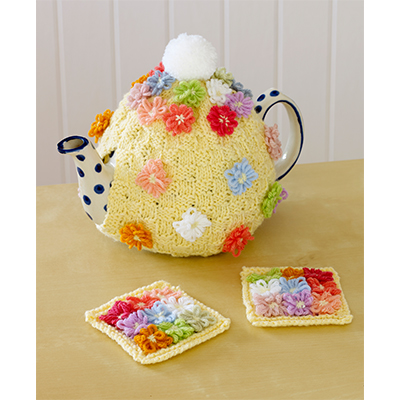
Flower Tea Cosy with Pompom
Designed by Sachiyo Ishii, this colourful flower-covered tea cosy combines basketweave-style knit-and-purl texture with a crown that is shaped in the round. It is designed for a medium teapot measuring approximately 9cm across the bottom and 15cm high.
The front and back are initially knitted separately on straight needles. Instead of shaping each piece separately and seaming all the way to the top, however, the two pieces are transferred to double-pointed needles and joined. The top of the cosy is then decreased in the round from 88 stitches down to 12.
The finished cosy is decorated with 32 loom-made flowers and a pom-pom.
Pattern details
- Designer: Sachiyo Ishii
- Free: Yes
- Format: Free pattern on Knitting Bee
- Teapot size: Medium
- Teapot measurements: Approximately 9cm bottom diameter × 15cm high
- Main yarn: Soft yellow DK; original yarn is 40% nylon, 30% wool and 30% acrylic
- Yarn weight: DK / 8-ply
- Needles: 3.5mm single-pointed needles and 3.5mm double-pointed needles
- Construction: Hybrid – front and back are knitted flat separately, then joined and the top is shaped in the round
- Main stitch pattern: Textured knit-and-purl basketweave-style pattern
- Techniques: Knit, purl, k2tog decreases, working flat, joining pieces to work in the round and knitting on DPNs
- Gauge: 24 stitches and 30 rows = 10cm × 10cm in stocking stitch
- Flowers: 32 loom-made flowers – 16 made on a circular loom and 16 on a square loom
- Top: Finished with a 35mm pom-pom
- Additional tools: Mini flower loom, small pom-pom maker, crochet hook and yarn needle
- Finishing: High – side seams are partially sewn to create the handle and spout openings, 32 flowers are arranged and attached, and the pom-pom is secured at the crown
- Difficulty: Not stated in the supplied pattern
- Best for: Medium teapots, textured knitting, knitters wanting to practise transitioning from flat knitting to knitting in the round, and anyone who enjoys highly decorative finishing.
What makes this pattern different:
Its flat-to-round construction makes this particularly interesting from a knitting-technique perspective. You get the convenience of working the main front and back on ordinary straight needles, then transfer all 88 stitches to DPNs and shape the crown seamlessly in the round.
It is also unusual because the flowers themselves aren’t knitted or crocheted. The design calls for a flower loom to make 16 circular and 16 square-loom flowers. That makes the decorative technique quite different from the knitted roses, knitted daffodils and crocheted daisies used on other floral cosies in this collection.
Get the free Flower Tea Cosy pattern
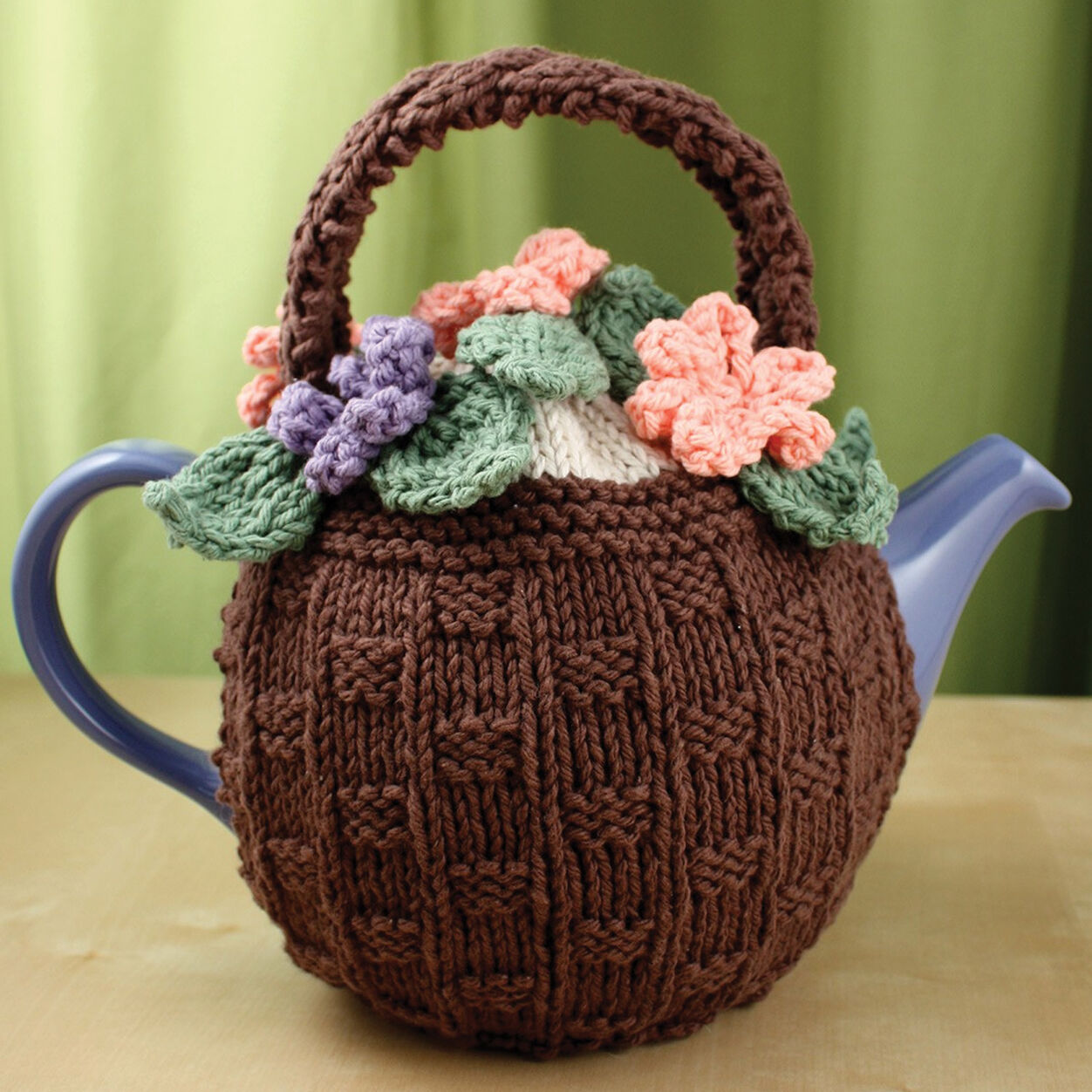
Lily Sugar’n Cream Flower Basket Tea Cozy
Designed to look like a basket filled with flowers, this Lily Sugar’n Cream tea cosy combines a textured knit-and-purl body, a cable-knit basket handle, knitted flowers and leaves.
The pattern is sized specifically for a 6-cup teapot and is knitted primarily on straight needles. The front and back are worked separately and seamed together, while the flowers, leaves and long decorative handle are all knitted separately and attached during finishing.
Yarnspirations rates the pattern Intermediate.
Pattern details
- Difficulty: Intermediate
- Free: Yes
- Format: Free downloadable PDF
- Teapot size: 6 cup
- Yarn: Lily Sugar’n Cream
- Yarn weight: Worsted / medium weight cotton
- Needles: 4.5mm (US 7) and 3.75mm (US 5) knitting needles
- Additional tool: Cable needle
- Construction: Front and back knitted flat as two matching pieces
- Main fabric: Textured knit-and-purl basket-style pattern, garter stitch and stocking stitch
- Techniques: Knit, purl, k2tog, ssk, slipped stitches, yarn overs, increases, decreases, shaping, cabling and seaming
- Gauge: 20 stitches and 26 rows = 10cm / 4 inches in stocking stitch using the larger needles
- Handle: Separately knitted 24cm / 9½in cable-patterned handle
- Flowers: Five knitted flowers
- Leaves: Ten knitted leaves
- Finishing: High – front and back are seamed while leaving openings for the handle and spout, then the flowers, leaves and separate cable handle are positioned and sewn onto the cosy
- Best for: 6-cup teapots, cable practice, textured knitting and knitters looking for a more involved floral tea cosy.
What makes this pattern different:
This design doesn’t simply attach flowers to an otherwise ordinary tea cosy. The entire cosy is designed to resemble a flower basket. The knit-and-purl texture creates the basket-like body, while a separately knitted cable strip forms its curved handle.
The cable itself is a straightforward C6F six-stitch cable, so this could also be an interesting smaller project for practising cable knitting before tackling a cable-heavy garment.
Get the free Flower Basket Tea Cozy PDF
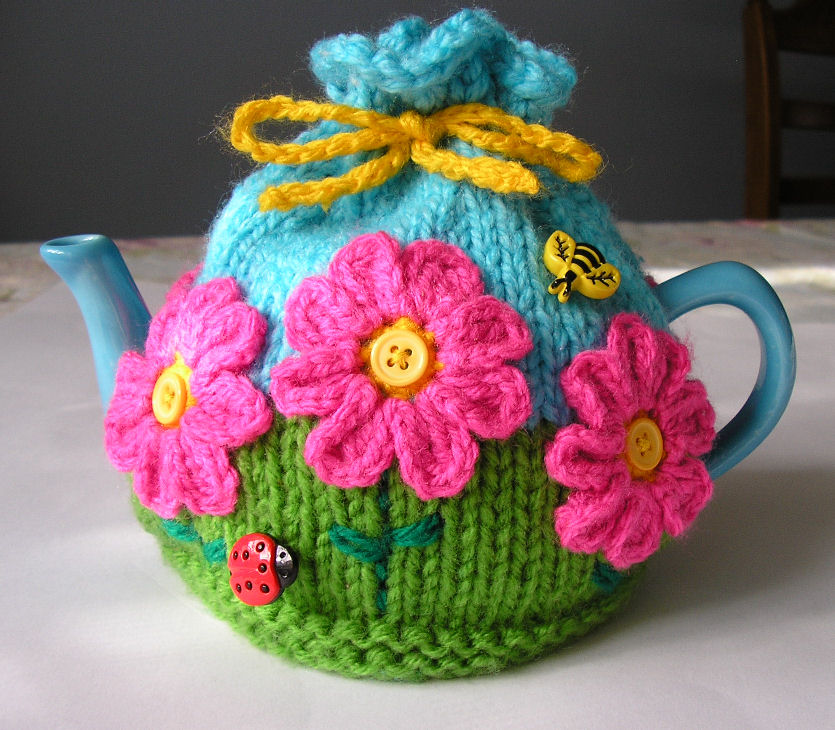
Flower Garden Tea Cosy
JustJen’s Flower Garden Tea Cosy is a cheerful little tea cosy originally designed for a 1-cup teapot, with additional instructions provided for making a larger version.
The cosy itself is straightforward, knitted flat in two pieces with two strands of DK yarn held together. Most of the body is simple stocking stitch, with an eyelet row near the top for a crocheted drawstring. The garden effect comes from six crocheted flowers, embroidered stems and leaves, and buttons used as flower centres.
Pattern details
- Free: Yes
- Format: Free webpage pattern
- Small size: 32cm circumference × 16cm high, designed for a 1-cup teapot
- Larger size: Designed for a teapot approximately 39cm circumference and 12–13cm high
- Yarn: 8-ply / DK
- Yarn weight: DK held double for the knitted cosy
- Needles: 5.5mm straight knitting needles
- Additional tool: 4mm crochet hook
- Construction: Knitted flat as two matching pieces
- Main stitches: Garter stitch and stocking stitch
- Techniques: Knit, purl, k2tog, yarn forward, eyelets, simple shaping, seaming and embroidery
- Gauge: 16 stitches and 23 rows = 10cm × 10cm in stocking stitch using DK yarn held double
- Flowers: Six crocheted eight-petal flowers
- Additional decoration: Embroidered stems, lazy-daisy leaves and six buttons for the flower centres
- Closure: Crocheted chain threaded through an eyelet row and tied in a bow
- Finishing: Moderate – the two pieces are partially seamed, six flowers are attached, stems and leaves are embroidered, buttons are sewn on and the drawstring is added
- Difficulty: Not formally rated; the designer describes the cosy and crochet flowers as easy
- Best for: 1-cup teapots, small tea cosies, DK stash yarn, straight-needle knitters and anyone who enjoys combining simple knitting with crochet and embroidery.
What makes this pattern different:
The 1-cup sizing immediately sets this pattern apart. At 32cm around, it’s specifically designed for a small individual teapot rather than requiring you to adapt a standard 4- or 6-cup cosy.
The pattern also offers a larger version for a 39cm-circumference teapot, making it more flexible than it initially appears.
Another useful feature is the construction of the main fabric. Rather than requiring bulky yarn, the designer holds two strands of ordinary DK together and knits them on 5.5mm needles. This makes the pattern potentially useful for using DK already in your stash.
The eyelet drawstring is practical as well as decorative. For the small version, the designer even suggests replacing the lower handle seam with crocheted ties or a button-and-loop fastening if you want the snug cosy to be easier to put on and remove.
Get the free Flower Garden Tea Cosy pattern
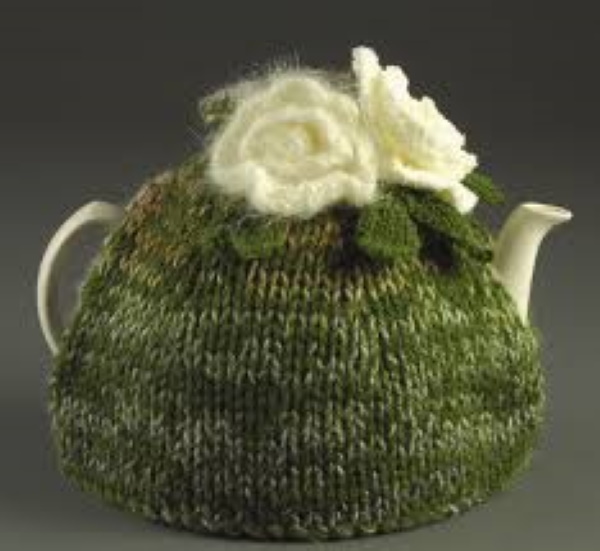
Tea Rose Tea Cosy
The Tea Rose Tea Cosy is an elaborate floral design with a particularly substantial construction: the cosy has separately knitted outer pieces and linings, which are sewn together before the two sides of the cosy are assembled.
The pattern also makes interesting use of yarn held together. The outer pieces use two strands of green DK plus one strand of tweed yarn, while each lining uses one strand of chunky yarn together with one strand of tweed DK. Large needles are used to knit these multi-strand fabrics.
The top is decorated with knitted roses made using two different constructions, together with knitted leaves.
Pattern details
- Free: Yes
- Format: Free downloadable PDF
- Teapot size: Not stated in the supplied pattern
- Outer yarn: Two strands of green DK plus one strand of tweed held together
- Lining yarn: One strand of grey chunky plus one strand of tweed DK held together
- Flower yarn: Brushed DK and fleece DK
- Leaf yarn: DK
- Needles: 7.5mm for the outer pieces, 6.5mm for the linings and 4mm for the roses and leaves
- Construction: Double layer – two outer pieces plus two separately knitted lining pieces
- Main stitch: Stocking stitch
- Techniques: Knit, purl, k2tog, p2tog, p3tog, k3tog, M1, yarn overs, skpo, kfb increases, shaping, gathering and seaming
- Roses: Two different knitted rose constructions
- Leaves: Six knitted leaves
- Finishing: High – each outer piece is first sewn to a lining, the two completed sides are then joined while leaving openings for the handle and spout, and the separately constructed roses and leaves are arranged and attached
- Difficulty: Not stated in the supplied pattern
- Best for: Double-layer tea cosies, floral designs, knitters interested in multi-strand knitting and those who enjoy detailed decorative finishing.
What makes this pattern different:
The construction is the standout feature. Each half of the tea cosy consists of two knitted layers, with an outer piece sewn directly to a separate lining before the two halves are joined. Combined with several strands of yarn held together, this creates a very different structure from a standard single-layer tea cosy.
The flowers are unusually detailed too. The pattern provides two completely different methods for knitting roses. One rose is assembled from separately knitted outer petals, inner petals and a centre, while the second is made from a rapidly increased strip that is wound into a flower shape.
That makes Tea Rose particularly useful for knitters interested in learning different ways to construct knitted flowers, rather than simply repeating the same embellishment across the entire cosy.
Get the free Tea Rose Tea Cosy PDF
Flower Pot Tea Cosy
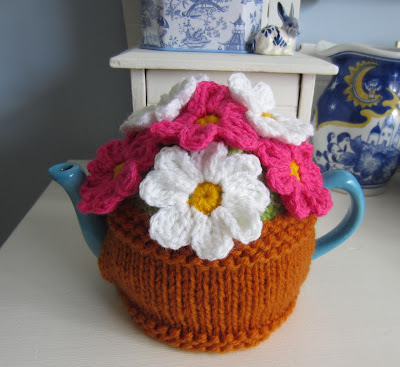
JustJen’s Flower Pot Tea Cosy turns a tiny teapot into a pot of colourful daisies. It is based on the designer’s Flower Garden Tea Cosy, but changes the colour placement, shaping and decoration to create the appearance of a terracotta flower pot topped with green foliage and ten crocheted flowers.
This is another pattern specifically designed for a very small teapot. The finished cosy measures approximately 32cm circumference × 16cm high and is intended for a 1-cup teapot; the designer notes that her own pot actually holds about 1½ cups.
The knitted portion is worked flat on straight needles using two strands of DK yarn held together.
Pattern details
- Free: Yes
- Format: Free webpage pattern
- Teapot size: 1 cup; designer’s example pot holds approximately 1½ cups
- Finished size: Approximately 32cm circumference × 16cm high
- Yarn: 8-ply / DK
- Yarn weight: DK held double for the knitted cosy
- Needles: 5.5mm straight knitting needles
- Additional tool: 4mm crochet hook
- Construction: Knitted flat as two matching pieces
- Main stitches: Garter stitch and stocking stitch
- Techniques: Knit, purl, k2tog decreases, shaping, gathering and seaming
- Gauge: 16 stitches and 23 rows = 10cm × 10cm in stocking stitch with DK held double
- Crochet required: Yes
- Flowers: Ten crocheted daisies – six pink and four white
- Finishing: Moderate – the flowers are attached to the two knitted sections, which are then partially seamed around the handle and spout
- Optional closure: The designer suggests a button-and-loop fastening on one side if preferred
- Difficulty: Not formally rated
- Best for: 1-cup teapots, small tea cosies, straight-needle knitting, DK stash yarn and knitters happy to combine knitting and crochet.
What makes this pattern different:
The clever part of this design is how the colour blocking becomes part of the object it represents. Terracotta-coloured knitting forms the flower pot, a six-row garter section creates its raised rim, green knitting becomes the foliage and the ten crocheted daisies form the flowers above it.
It’s also a good example of how a very simple tea cosy construction can produce a much more elaborate-looking novelty design. The knitted body requires mainly garter stitch, stocking stitch and k2tog shaping; most of the visual effect comes from colour placement and the separately crocheted flowers.
The pattern is a variation of JustJen’s Flower Garden Tea Cosy, so knitters comparing the two should choose Flower Garden for the embroidered garden design and drawstring top, or Flower Pot for the more three-dimensional flower-pot effect.
Get the free Flower Pot Tea Cosy pattern
Rosie Posie Tea Cosy
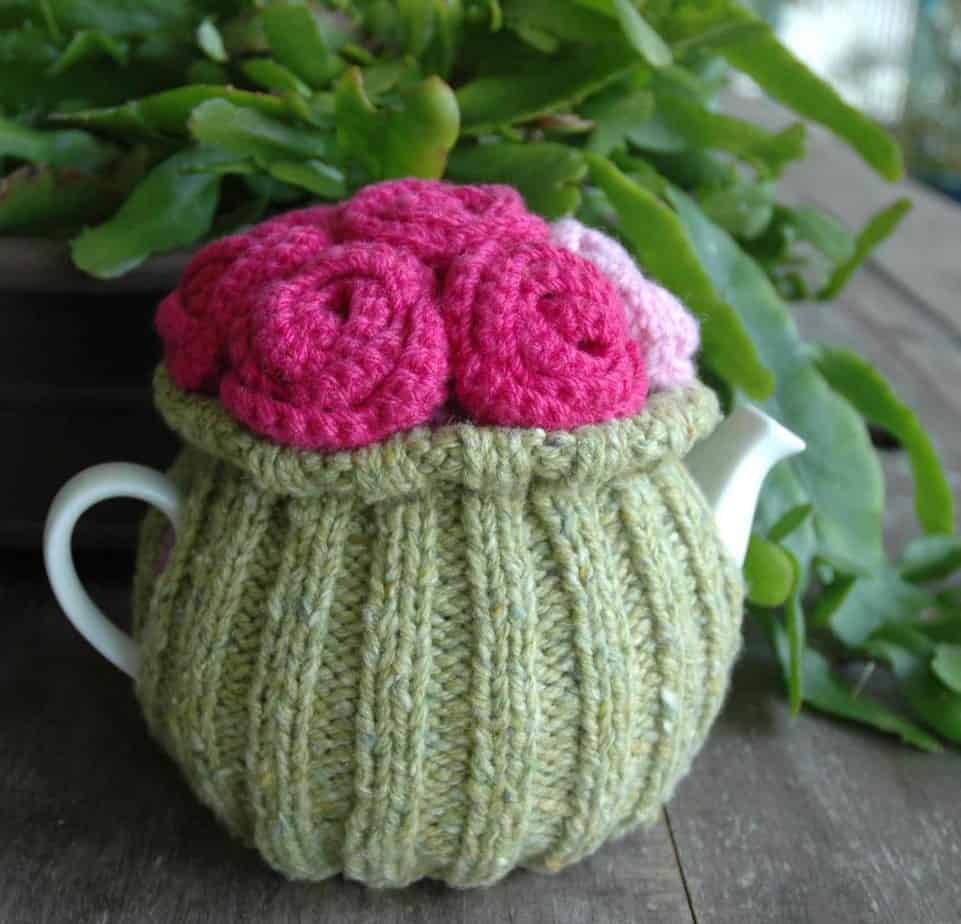
The Rosie Posie Tea Cosy is a substantial floral cosy designed for a six-cup teapot, with an unusual integrated double-layer construction.
Instead of knitting an outer cosy and lining separately, the entire piece is worked continuously on double-pointed needles. Once completed, the long knitted “sock” is folded back inside itself to create the lining, producing inner and outer layers from one continuous piece of knitting.
The cosy is finished with a dramatic arrangement of nine roses at the top, and the pattern provides instructions for making the roses either knitted or crocheted.
Pattern details
- Free: Yes
- Format: Free webpage pattern
- Teapot size: 6 cup
- Main yarn: 8-ply yarn
- Yarn weight: DK / 8-ply
- Needles: Five 5mm double-pointed needles
- Additional tool: 4mm crochet hook for the crocheted version of the roses and rose beds
- Construction: Integrated double layer – outer cosy and lining are knitted continuously as one piece and then folded inside itself
- Main stitch: K2, P2 rib
- Techniques: Knitting in the round, working back and forth on DPNs, ribbing, dividing and rejoining sections for handle and spout openings, seaming and finishing
- Flowers: Nine roses – eight red and one pink
- Rose options: Instructions are provided for both knitted and crocheted roses
- Rose bed: Two crocheted circular rose beds are used to support and finish the floral arrangement
- Finishing: High – the knitted cosy is folded to form its lining, inner and outer layers are joined around the openings, the rose bed is attached through both layers and nine roses are arranged and sewn into place
- Difficulty: Not stated in the supplied pattern
- Best for: 6-cup teapots, double-layer cosies, knitters comfortable with DPNs, ribbing and knitting in the round, and anyone looking for a substantial floral tea cosy.
What makes this pattern different:
The most interesting feature is its one-piece integrated lining. Rather than knitting four pieces for a traditional lined cosy, the outer layer flows directly into the inner layer. The completed knitting is folded back on itself so that half becomes the lining.
The handle and spout openings are also incorporated into this continuous construction. The stitches are divided and worked back and forth before being rejoined in the round, and the process is repeated for the lining section.
The flowers offer another unusual choice. You can make the nine roses using the knitted rose instructions or the crocheted version. The roses sit on a separately crocheted circular “rose bed”; an optional second rose bed can be sewn inside the top of the cosy to conceal the finishing threads.
Get the free Rosie Posie Tea Cosy pattern
Fresh as a Daisy Tea Cosy
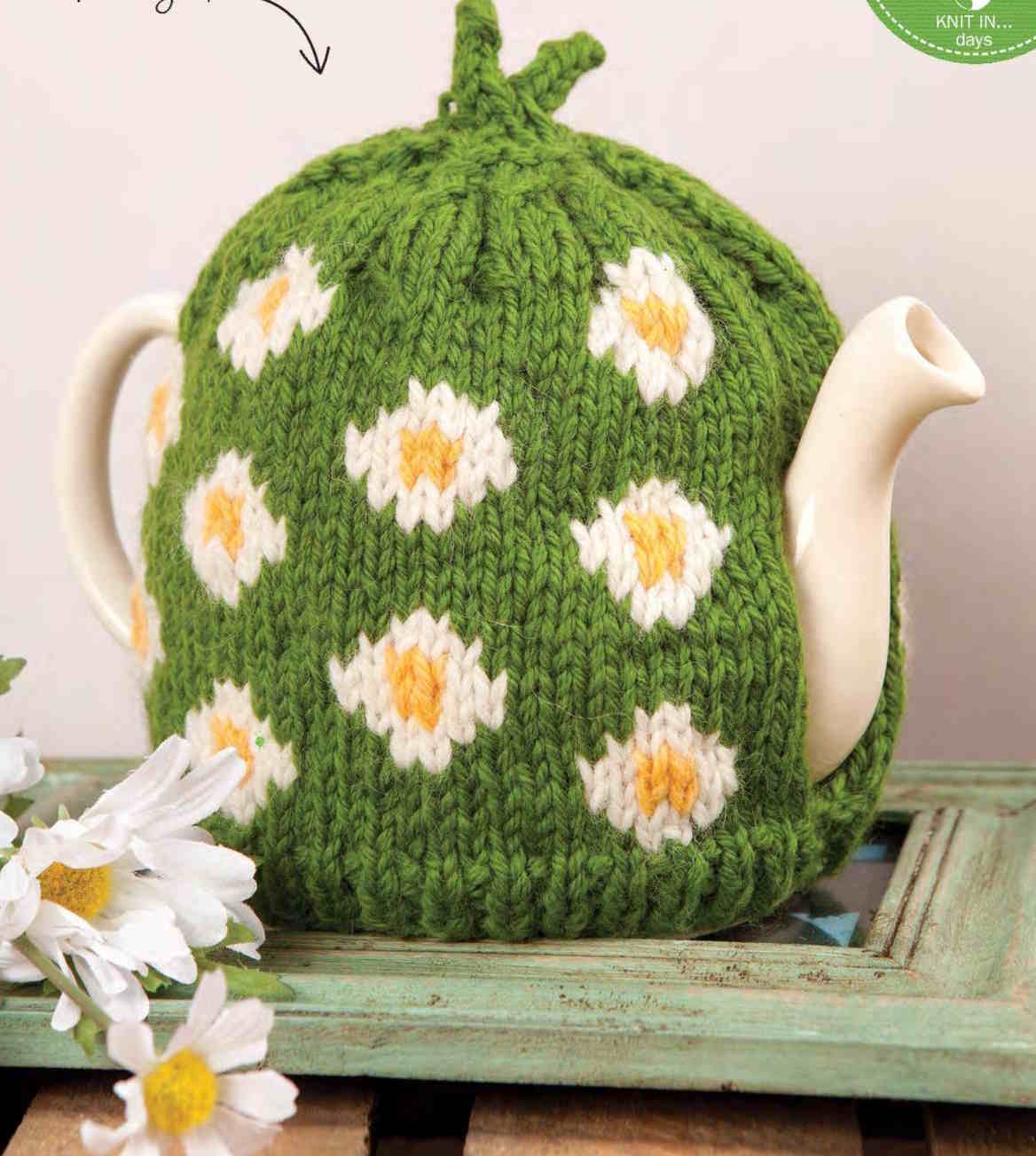
Fresh as a Daisy is a colourful stranded-colourwork tea cosy knitted flat in two matching pieces. The daisy motif is worked from a chart using three colours, while the upper section changes to textured ribbing before being shaped towards a small I-cord top.
The designer also gives a useful alternative if working three colours in the same row feels awkward: knit the daisies using two colours and add the third colour afterwards using duplicate stitch (Swiss darning).
Pattern details
- Yarn: John Arbon Knit By Numbers DK plus Organic Falklands Merino Aran
- Yarn weight: DK and Aran; the main DK yarn and contrast DK are held double throughout
- Needles: 4mm straight needles plus 4mm DPNs
- Finished size: 46cm circumference × 20cm tall
- Construction: Knitted flat in two matching sides
- Colourwork: Charted three-colour daisy motif
- Techniques: Ribbing, stocking stitch, stranded colourwork, chart reading, k2tog, p2tog, shaping, I-cord and mattress stitch
- Alternative colourwork technique: The third colour can be added afterwards using duplicate stitch/Swiss darning
- Finishing: Mattress-stitch seams with separate openings left for the teapot handle and spout
- Difficulty: Not stated in the supplied pattern information
- Teapot capacity: Not stated; use the finished measurement of 46cm circumference × 20cm tall to compare with your teapot
- Best for: Knitters wanting to practise stranded colourwork, following a chart and simple I-cord while still working the main tea cosy on straight needles.
What makes this pattern different:
This is a particularly good colourwork practice tea cosy. Unlike many simple striped designs, the daisies are worked from a chart using multiple colours. The option of adding one colour later with Swiss darning also makes the design more approachable if you don’t want to manage three colours across a row.
Get the Daisy Tea Cosy Pattern
Roses and Bees Tea Cosy
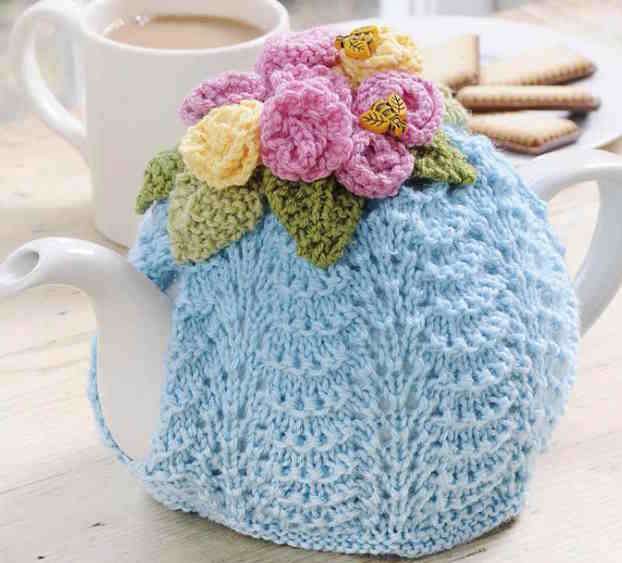
This colourful floral tea cosy combines a simple lace-patterned body with separately knitted roses and leaves, finished with small bee buttons among the flowers. It is worked entirely flat on straight needles, with two matching pieces sewn together around the teapot.
The pattern is designed to fit an average teapot, although no cup capacity or finished circumference is provided.
Pattern details
- Format: Written knitting pattern
- Teapot size: Average teapot
- Finished dimensions: Not stated
- Yarn: Patons Diploma Gold DK
- Yarn weight: DK
- Main colour: Bright Aqua
- Contrast colours: Pastel Pink, Lemon and Apple Green
- Needles: 3.75mm and 4mm straight knitting needles
- Gauge: 22 stitches and 30 rows = 10cm / 4in using 4mm needles
- Construction: Two matching pieces knitted flat
- Main stitch pattern: Four-row lace pattern
- Techniques: Knit, purl, p2tog, yarn overs, k2tog, increases, k3tog, basic shaping and seaming
- Body height before crown shaping: 15cm / 6in, or the required length to reach the top of the teapot
- Flowers: Separately knitted curled roses
- Leaves: Separately knitted shaped leaves with a central purl stitch
- Additional decoration: Three bee buttons
- Handle and spout openings: Created by leaving gaps when the two sides are seamed
- Finishing: Moderate – includes seaming, forming and attaching roses, knitting and positioning leaves and sewing on bee buttons
- Difficulty: Not stated in the supplied pattern
- Best for: Straight-needle knitting, DK yarn, floral tea cosies, simple lace and knitters who enjoy adding decorative details.
What makes this pattern different:
Unlike some of the heavily embellished floral tea cosies in this collection, the decorative elements here are built around a relatively simple four-row repeating lace pattern.
The body uses yarn overs and paired decreases to create an openwork effect before straightforward decreases shape the crown. This gives the background fabric some visual interest without requiring cables, stranded colourwork or circular knitting.
The roses use another clever but accessible construction. A short strip is increased from 12 to 24 stitches and then cast off using yarn overs. The resulting piece naturally curls and is wound into a rose before being secured with a few stitches.
The leaves are knitted separately and shaped gradually from five stitches to eleven before decreasing to a point. A central purl stitch creates a simple vein-like detail.
The final touch is particularly distinctive: three small bee buttons are positioned among the flowers, turning an otherwise traditional rose-covered tea cosy into a more playful floral design.
Roses and Bees Tea Cosy Pattern
Cable, Brioche & Textured Tea Cosy Knitting Patterns
Tea cosies are excellent small projects for experimenting with texture.
If you want to practise before starting a cable project, browse the Knitting Bee Cable Knitting Stitch Library, where you’ll find cable stitches with written instructions.
There is a useful progression within this tea cosy collection itself.
The Twisted Stitch Tea Cosy is a gentle introduction because its Tw2R stitch produces a cable-like twist without a cable needle.
Flower Basket introduces a proper cable in its separately knitted handle.
Sheryl’s Tea Cozy makes cables much more prominent, with the cable width changing as the cosy is shaped.
Cosy Cables uses an 8-row diamond cable pattern and combines flat and circular construction.
At the more involved end, the Patons Aran Sweater Tea Cozy behaves almost like a miniature Aran cardigan, with several cables, chart reading, button bands, buttonholes and ribbing picked up around the handle and spout openings.
For more ways of creating texture without cables, explore the complete Knitting Stitch Library.
Smocked and Twisted Tea Cosies
The Patons Cushy Smocked Tea Cozy is particularly interesting because its raised texture doesn’t require a cable needle. Long loops are drawn across groups of stitches to gather the ribbed fabric into a smocked surface.
This places it nicely between basic ribbing and true cable knitting.
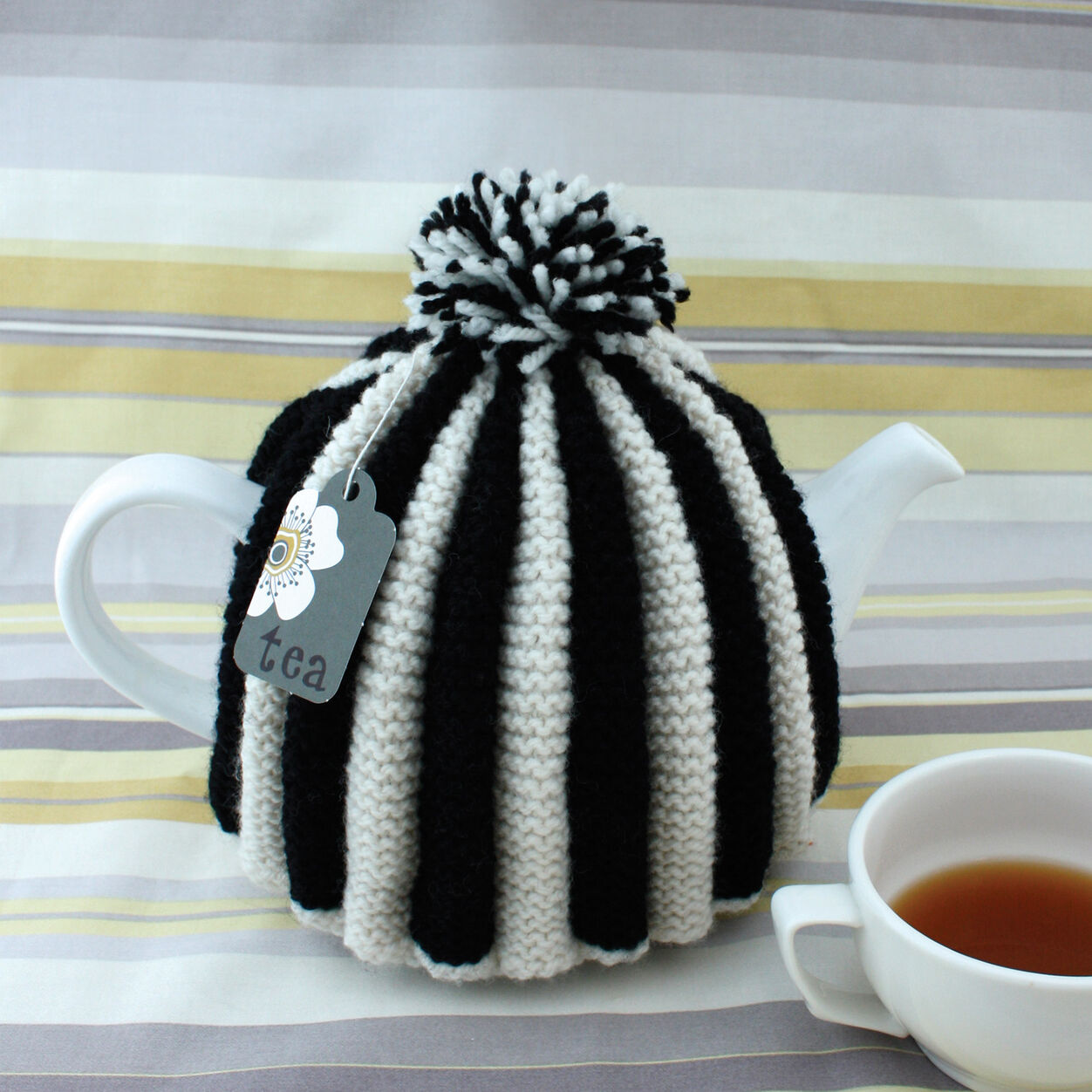
Patons Classic Pleated Tea Cozy
This clever Patons tea cosy creates its distinctive pleated fabric using deliberately tight stranded colourwork. Rather than carrying the unused colour loosely behind the work as you normally would with stranded knitting, the floats are intentionally kept short so they pull the fabric together into deep pleats.
The pattern comes in three sizes, from a small 2-cup pot through to a 6–8-cup teapot, making it one of the most versatile patterns in this collection for teapot sizing.
Pattern details
- Free: Yes
- Format: Free downloadable PDF
- Teapot sizes: 2 cup, 4–6 cup and 6–8 cup
- Yarn: Patons Classic Wool
- Yarn weight: Worsted / medium weight
- Fibre: 100% wool
- Needles: 4.5mm (US 7) knitting needles
- Construction: Knitted flat in two matching pieces
- Colourwork: Two-colour stranded knitting
- Main technique: Intentionally shortened/tight floats draw the fabric together to create the pleated effect
- Techniques: Knit stitch, stranded colourwork, carrying two colours, k2tog and k3tog decreases, shaping, gathering and seaming
- Gauge: 20 stitches and 26 rows = 10cm / 4 inches in stocking stitch
- Finishing: Two pieces are seamed together, leaving openings for the handle and spout; the remaining top stitches are gathered and a two-colour pom-pom is attached
- Difficulty: Not stated in the supplied pattern
- Best for: Knitters wanting to practise stranded colourwork, anyone looking for a traditional thickly textured tea cosy, and knitters needing a pattern with several teapot sizes.
What makes this pattern different:
The pleats aren’t created with ordinary ribbing or a textured stitch pattern. Instead, Patons deliberately uses tight stranded floats to pull sections of the knitting together, turning something knitters would normally try to avoid in stranded colourwork into the main design feature. The resulting concertina-like fabric also creates considerably more depth than a simple flat layer of stocking stitch.
Get the free Patons Classic Pleated Tea Cozy PDF
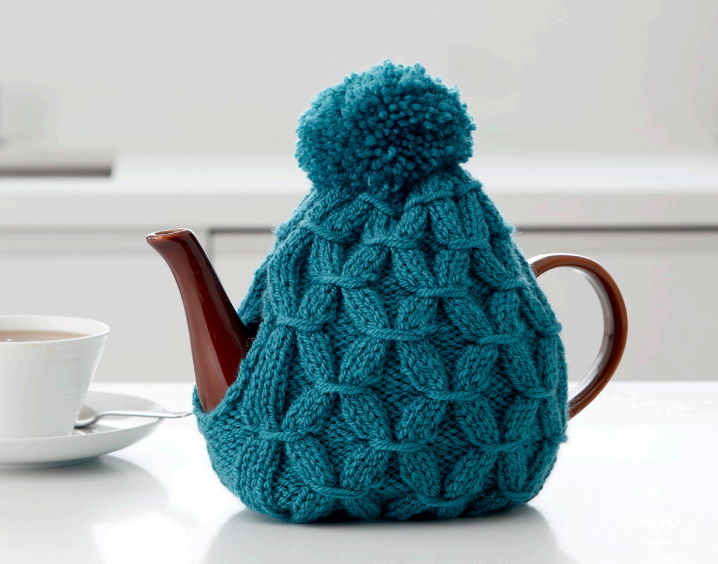
Patons Cushy Smocked Tea Cozy
The Patons Cushy Smocked Tea Cozy creates a deeply textured, gathered-looking fabric using a clever smocking technique, while the actual cosy construction remains straightforward. It is knitted entirely on straight needles in two matching pieces and is officially rated Easy.
Designed to fit a 6-cup teapot, this is a particularly good choice for knitters who want something more decorative than basic rib or garter stitch without moving into cables, colourwork or circular knitting.
Pattern details
- Difficulty: Easy
- Free: Yes
- Format: Free downloadable PDF
- Teapot size: 6-cup
- Yarn: Patons Decor
- Yarn weight: Worsted / medium
- Yarn amount: 1 x 100g / 190m ball
- Needles: 4.5mm (US 7) straight knitting needles
- Construction: Two matching pieces knitted flat
- Main stitch pattern: Textured smocked pattern based on knit and purl ribbing
- Techniques: Knit, purl, drawing up long loops to form the smocking, k2tog, p2tog, gathering and seaming
- Gauge: 20 stitches and 26 rows = 10cm / 4in in stocking stitch
- Body length before shaping: Approximately 8in / 20.5cm
- Crown shaping: Rapid decreases reduce 51 stitches to 34, then 17 stitches before the remaining stitches are gathered
- Handle and spout openings: Created during seaming
- Finishing: Two side seams are sewn for 3¼in / 8.5cm from both the upper and lower edges, leaving openings between them for the handle and spout
- Decoration: Yarn pom-pom
- Best for: 6-cup teapots, straight-needle knitting, textured stitches and knitters wanting an Easy pattern with a more unusual surface design.
What makes this pattern different:
The interesting part of this cosy is how the smocked texture is constructed without using cable stitches.
The basic fabric begins with groups of three knit and three purl stitches. On selected rows, the right-hand needle is inserted much further across the stitches than usual and a long loop is drawn through the fabric. That loop is placed onto the left-hand needle and knitted together with the next stitch.
These gathering points alternate across the pattern, pulling sections of the ribbed fabric together and producing the cushioned, smocked appearance.
Despite that unusual stitch manipulation, the overall construction is very traditional. Two identical 51-stitch pieces are worked flat to approximately 8in before the crown is rapidly decreased and gathered. The sides are then partially seamed, leaving the central sections open for the teapot’s handle and spout.
This makes Cushy Smocked particularly useful for a knitter who wants to explore a new texture without learning cables, stranded colourwork or circular knitting.
Get the free Patons Cushy Smocked Tea Cozy PDF
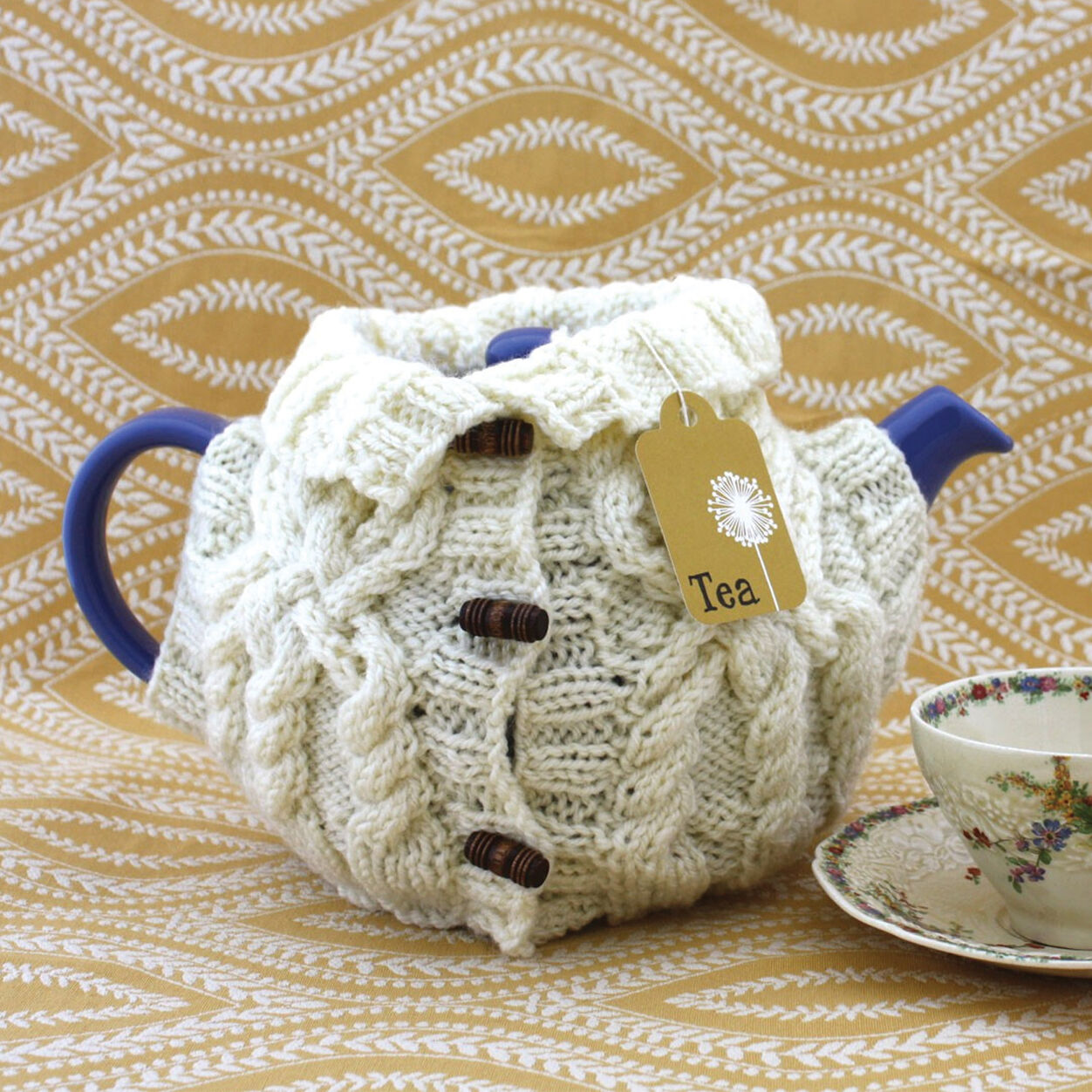
Patons Aran Sweater Tea Cozy
The Patons Aran Sweater Tea Cozy is designed to resemble a miniature traditional Aran cardigan wrapped around a teapot. Sized for a 6–8 cup teapot, it combines an elaborate cable pattern with ribbing, button bands and three toggle fastenings.
Unlike a basic two-piece tea cosy, the body is constructed as a back, right front and left front. These sections are eventually joined across the top, while the front remains cardigan-like with separate button and buttonhole bands.
Pattern details
- Difficulty: Intermediate
- Free: Yes
- Format: Free downloadable PDF
- Teapot size: 6–8 cup
- Yarn: Patons Decor
- Yarn weight: Medium / worsted
- Needles: 4.5mm (US 7) straight knitting needles
- Additional needles: Set of four 4.5mm (US 7) double-pointed needles
- Additional tools: Cable needle, stitch holder and three small button toggles
- Construction: Back plus separate right and left fronts, joined before the upper ribbing is completed
- Main stitches: Ribbing and Aran-style cable pattern
- Cable techniques: C6F, C6B, T5F and T5B
- Other techniques: Knit, purl, M1, M1P, k2tog, p2tog, yarn overs, increases, decreases, picking up stitches, buttonholes, working ribbing in the round, seaming and chart reading
- Gauge: 20 stitches and 26 rows = 10cm / 4in
- Front closure: Ribbed button and buttonhole bands with three toggle fastenings
- Handle and spout openings: Stitches are picked up around each opening and worked in K2, P2 rib on DPNs
- Finishing: Moderate to high – side seams are partially sewn, front bands are added, toggles attached and separate ribbed edgings are worked around the handle and spout openings
- Best for: 6–8 cup teapots, cable knitters, Aran-style knitting and anyone looking for a tea cosy that offers some of the techniques found in a small garment project.
What makes this pattern different:
This is one of the most garment-like tea cosy constructions in the collection. Instead of simply knitting two shaped rectangles and sewing them together, you’re essentially constructing a miniature Aran cardigan for a teapot.
The cable pattern is also considerably more involved than a single repeating cable. It combines six-stitch front and back cables with five-stitch travelling cable movements, creating the interlaced Aran-style panel across the body.
There are useful finishing techniques to practise too. Stitches are picked up along the two front edges to create separate button and buttonhole bands, while stitches around the handle and spout openings are picked up onto DPNs and finished with ribbing in the round.
The three toggle fastenings aren’t merely decorative: the pattern includes three yarn-over buttonholes in the front band, reinforcing the miniature-sweater appearance.
Get the free Patons Aran Sweater Tea Cozy PDF
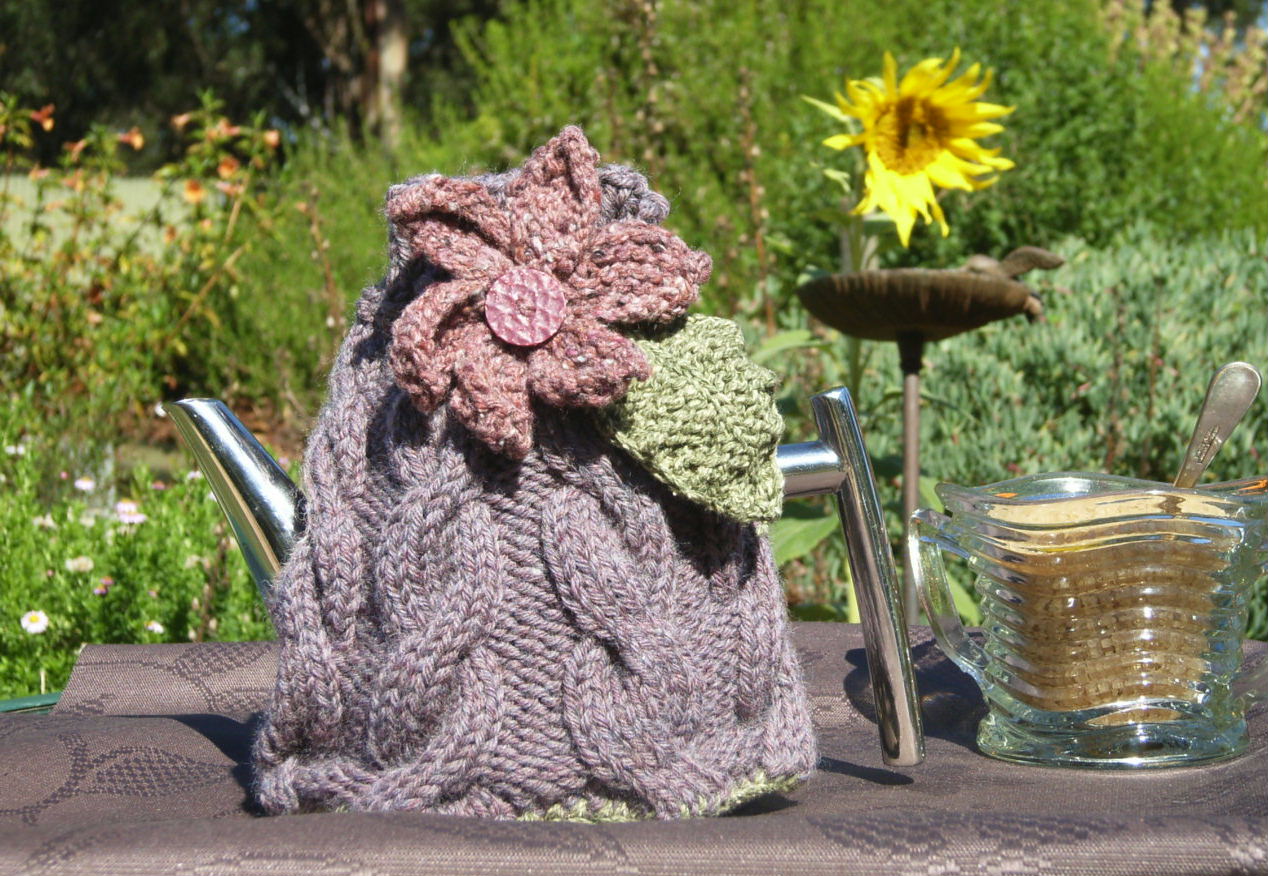
Sheryl’s Tea Cozy
Designed by Kristy Harrison, Sheryl’s Tea Cozy was created specifically for an Avanti 6-cup teapot with a longer, less-rounded shape than a conventional teapot. The chunky yarn, large cables and optional knitted embellishments give it a traditional country-style appearance.
The main cosy is knitted flat in two matching pieces using 12-ply yarn and 6mm needles. Large cables become progressively smaller as the cosy narrows toward the top, before an eyelet row and ribbed upper edge complete the body.
Pattern details
- Designer: Kristy Harrison
- Free: Yes
- Format: Free downloadable PDF
- Teapot size: Avanti 6-cup teapot
- Teapot shape: Longer and less rounded than a conventional teapot
- Finished circumference: Approximately 40cm / 15¾in around the base
- Finished height: Approximately 16cm / 6¼in
- Main yarn: Bendigo Woollen Mills 12-ply Rustic
- Main yarn amount: Approximately 60g
- Embellishment yarn: Small amounts of Jo Sharp DK tweed in contrasting colours
- Needles: 6mm straight knitting needles
- Additional tool: Cable needle
- Crochet hook: 4mm for the lower edging
- Construction: Two matching pieces knitted flat and seamed at the sides
- Main stitch pattern: Large cables combined with reverse-stockinette sections
- Cable progression: Eight-stitch cables reduce to six-stitch and then four-stitch cables as the cosy is shaped
- Other techniques: Knit, purl, cables, k2tog, yarn-forward eyelets, garter stitch, ribbing, seaming and crochet edging
- Top: Eyelet row followed by garter stitch and ribbing
- Handle and spout openings: Created by leaving gaps when the side seams are sewn
- Finishing: Moderate to high depending on embellishments chosen
- Original embellishments: Knitted leaf, 3-stitch I-cord and short-row windmill flower attached with a button
- Simpler finishing option: The designer suggests threading ribbon with beads or a 4-stitch I-cord through the eyelets and tying it in a bow
- Difficulty: Not stated in the supplied pattern
- Best for: Longer 6-cup teapots, chunky cables, straight-needle knitting and knitters who enjoy decorative finishing.
What makes this pattern different:
Sheryl’s Tea Cozy is particularly useful because the designer tells us what shape of teapot she designed it to fit. The original Avanti 6-cup pot is longer and less rounded than many traditional teapots, and the finished cosy measures approximately 40cm around the base and 16cm high.
That’s an important distinction when choosing a tea cosy pattern. Two teapots can both be labelled “6-cup” while having quite different proportions, so knowing the finished dimensions and intended pot shape can be more useful than capacity alone.
The cable construction is also interesting. The cosy starts with broad eight-stitch cable crossings. As decreases narrow the fabric, these become six-stitch cables and eventually four-stitch cables. The cable design therefore changes with the shaping rather than simply stopping when the crown begins.
An eyelet row near the top provides several finishing possibilities. The original version uses a knitted leaf, I-cord and short-row windmill flower, but the designer also suggests a much simpler ribbon-and-bead or I-cord tie.
Get the free Sheryl’s Tea Cozy PDF
Brewed in Brioche Tea Cosy
Designed by Trish Campbell for Estelle Yarns, the Brewed in Brioche Tea Cosy is a two-colour brioche pattern designed for a standard 4-cup teapot. Estelle rates it Advanced, making it one of the more technically demanding tea cosy patterns in this collection.
The two sides begin separately with brioche worked flat. Their live stitches are then transferred to a circular needle and joined so the upper section and crown can be completed using two-colour brioche in the round.
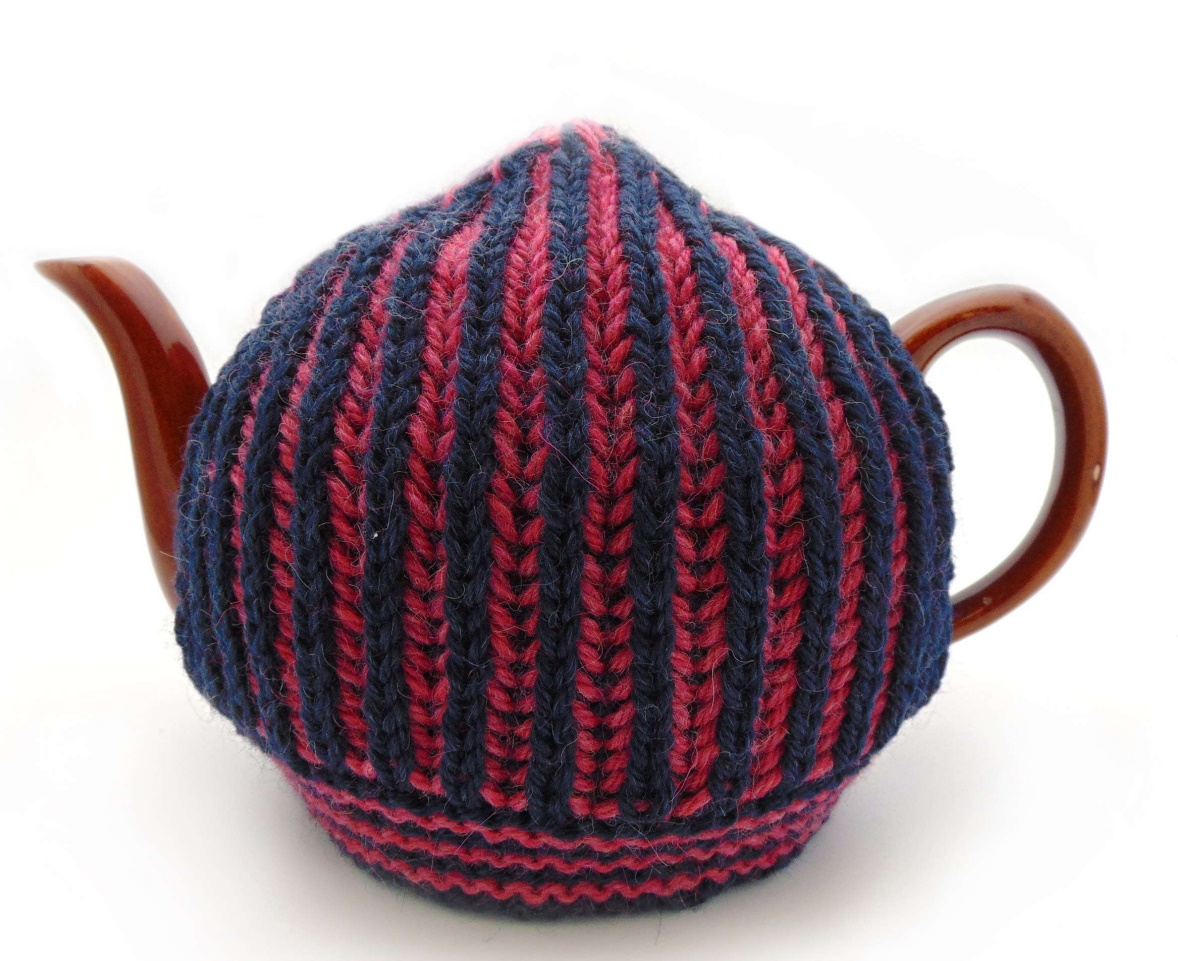
Pattern details
- Designer: Trish Campbell
- Difficulty: Advanced
- Free: Yes
- Format: Free downloadable PDF
- Teapot size: Standard 4-cup teapot
- Finished width: 15½in / approximately 39.5cm
- Finished height: 7in / approximately 18cm
- Yarn: Estelle Alpaca Merino Worsted
- Yarn weight: Worsted
- Colours: Two contrasting colours
- Needles: 4mm (US 6), 40cm / 16in circular needle
- Additional needles: 4mm (US 6) DPNs for the final crown shaping
- Additional tools: Cable needle, used for the centred brioche decrease, and stitch holder
- Construction: Two lower sides worked flat, then joined to work the upper cosy and crown in the round
- Main stitch pattern: Two-colour brioche
- Brioche techniques: brk1, brp1, sl1yo, brk2tog, right- and left-slanting brioche decreases and a centred four-stitch brioche decrease
- Other techniques: Cable cast-on, sliding stitches to work the same row twice, working with two colours, joining in the round and switching from a circular needle to DPNs
- Gauge: 17 stitches and 22 rows = 10cm / 4in in brioche pattern
- Handle and spout openings: Created by knitting the two lower sides separately before joining them above the openings
- Crown shaping: Shaped with paired right- and left-slanting brioche decreases followed by centred brioche decreases
- Finishing: Relatively little sewing compared with its technical difficulty – the lower edges are seamed only up to where the brioche begins
- Best for: Experienced knitters, two-colour brioche, learning brioche shaping and knitters wanting a small project that combines flat and circular brioche.
What makes this pattern different:
This is the only tea cosy in this collection so far where brioche itself is the main technical challenge, rather than simply being used as a decorative detail.
The flat section demonstrates an important feature of two-colour brioche: each row is effectively worked twice. One colour is worked across the row, the stitches are slid back rather than the work being turned, and the same row is then worked with the second colour. The process is repeated from the opposite side.
After the two lower sections are complete, their live stitches are placed together on a circular needle. From this point, the method changes to two-colour brioche in the round, with one round worked in the main colour followed by one in the contrast colour.
The crown goes beyond basic brioche by introducing specifically shaped decreases. Right- and left-slanting brioche decreases are positioned symmetrically through the crown, followed eventually by a centred four-stitch brioche decrease worked over five stitches.
That combination makes this much more than a textured tea cosy: it is a compact project for practising how two-colour brioche behaves flat, in the round and during shaped decreases.
Get the free Brewed in Brioche Tea Cosy PDF
Cosy Cables Tea Cosy
Designed by Trish Campbell for Estelle Yarns, the Cosy Cables Tea Cosy features a repeating diamond cable pattern and is specifically sized for a standard 2-cup teapot.
The construction combines flat and circular knitting. Two cable-patterned sides are knitted separately, then their live stitches are placed together on a circular needle and joined in the round to shape the top of the cosy.
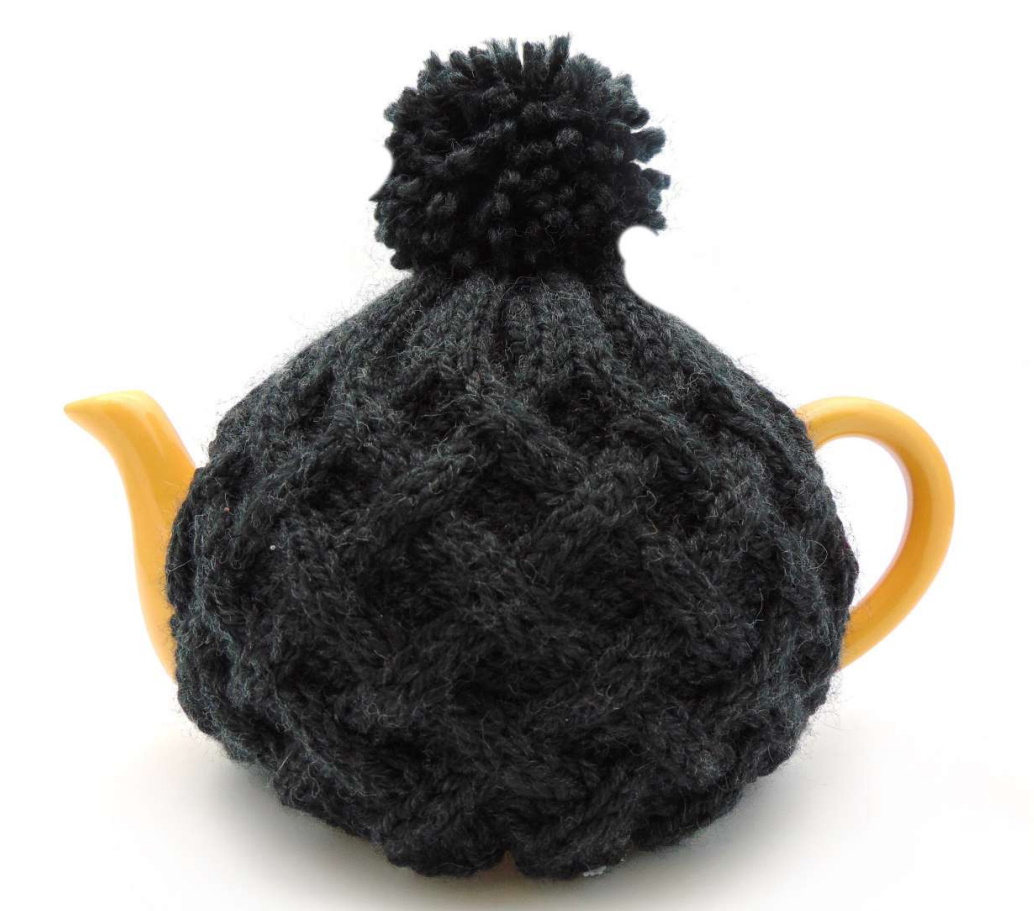
Pattern details
- Designer: Trish Campbell
- Difficulty: Intermediate
- Free: Yes
- Format: Free downloadable PDF
- Teapot size: Standard 2-cup teapot
- Finished width: 12in / 30.5cm
- Finished height: 5in / 12.7cm
- Yarn: Estelle Worsted Heathers or Estelle Worsted
- Yarn weight: Worsted
- Fibre: 50% acrylic, 40% wool, 10% nylon
- Needles: 4.5mm (US 7) 40cm / 16in circular needle
- Additional needles: 4.5mm DPNs for the final crown shaping
- Additional tools: Cable needle, stitch holder and stitch marker
- Construction: Two sides knitted flat, then joined and worked in the round to complete the top
- Main stitch pattern: Eight-row Diamond Cable Pattern
- Cable techniques: C4B, C4F, T4B and T4F
- Other techniques: Knit, purl, M1P, SSK, k2tog, p2tog, decreasing, working in the round, mattress stitch and cable knitting
- Gauge: 32 stitches and 30 rows = 10cm / 4in in Diamond Cable Pattern
- Crown shaping: Worked in the round with progressive decreases, switching to DPNs when necessary
- Finishing: Moderate – short lower side seams are worked in mattress stitch and a small pom-pom is attached to the top
- Best for: 2-cup teapots, cable knitting, practising travelling cables and knitters ready to combine flat and circular construction.
What makes this pattern different:
This is a particularly good example of a tea cosy that combines flat cable knitting with an in-the-round finish.
Each side begins with 38 stitches and increases to accommodate the cable pattern. The main design is an eight-row diamond cable repeat using both ordinary four-stitch cables and travelling cable stitches. These movements cause the cable columns to cross and shift across the fabric to create the diamond shapes.
Instead of casting off the two sides when the cable sections are complete, their stitches are kept live. Both sets are then placed onto a circular needle and joined in the round for the crown. Progressive decreases close the top, with the pattern instructing the knitter to switch to DPNs once there are too few stitches for the circular needle.
This makes Cosy Cables an interesting middle ground between a simple flat cable tea cosy and the more elaborate Patons Aran Sweater Tea Cozy. Both are officially rated Intermediate, but Cosy Cables concentrates primarily on the diamond cable pattern and crown construction, while the Aran Sweater adds multiple garment-style sections, buttonholes, front bands, toggles and picked-up ribbed edgings.
Get the free Cosy Cables Tea Cosy PDF
Fair Isle, Stranded and Colourwork Tea Cosies
Not all colourwork tea cosies use the same technique.
At the simplest end are stripes, where only one colour is generally being knitted at a time.
Slip-stitch colourwork can create more complex-looking patterns while still working with one active yarn at a time. You can see more examples in Knitting Bee’s Slip Stitch Knitting Patterns.
Stranded knitting requires two colours to be carried across a row or round.
The Cascade Fair Isle Tea Cozy is a useful introduction to this style because its colourwork uses a simple repeating sequence rather than an elaborate pictorial motif.
The Wee County Yarns Fair Isle Tea Cosy goes considerably further. It is worked in the round using charted Fair Isle and then steeked to create the openings.
That makes it a particularly interesting small project for someone who wants to experience cutting stranded knitting without committing to an entire Fair Isle cardigan.
Union Jack Tea Cosy by Audrey’s Teashop
The Union Jack Tea Cosy by Audrey’s Teashop combines charted red, white and blue colourwork with a separate knitted lining, creating a double-layer tea cosy with a classic British design.
The outer is worked in garter stitch following a Union Jack colour chart, while the inner is knitted separately, mainly in stocking stitch. Two outer pieces and two lining pieces are made, then each outer is joined to its lining before the completed halves are assembled around the teapot.
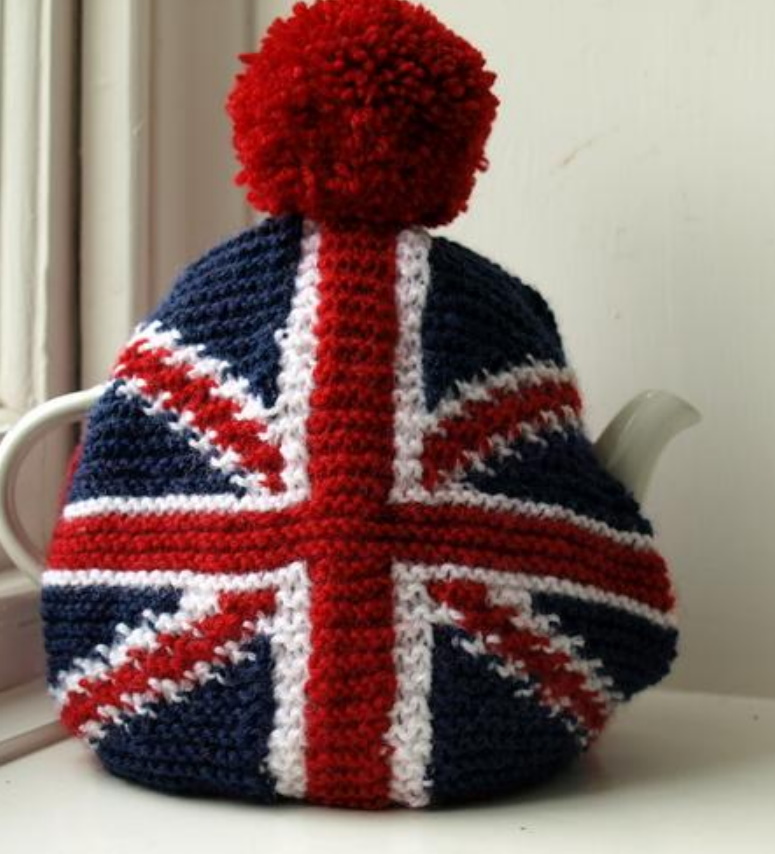
Pattern details
- Designer: Audrey’s Teashop
- Free: Yes
- Format: Free downloadable PDF
- Teapot size: Not stated in the supplied pattern
- Yarn: DK in red, royal blue and white
- Yarn weight: DK
- Needles: 4mm straight knitting needles
- Gauge: 22 stitches and 28 rows = 10cm / 4in
- Construction: Double layer – two knitted outer pieces plus two separately knitted inner pieces
- Outer fabric: Garter stitch with charted Union Jack colourwork
- Inner fabric: Garter-stitch beginning followed by stocking stitch
- Techniques: Knit, purl, chart reading, colour changes, decreasing, seaming and assembling a lined cosy
- Shaping: Both outer and lining are gradually decreased toward the top
- Handle and spout openings: Positioned during assembly by fitting the cosy to the teapot
- Top: Large pom-pom
- Finishing: Moderate to high – four main pieces must be knitted, each outer attached to its lining, the two lined halves joined around the handle and spout openings, and a pom-pom made and attached
- Difficulty: Not stated in the supplied pattern
- Best for: Straight-needle knitters, Union Jack designs, charted colourwork and knitters looking for a double-layer tea cosy without circular knitting.
What makes this pattern different:
This is one of the relatively few patterns in the collection that combines decorative charted colourwork with a complete knitted lining.
The construction is particularly useful to compare with other lined cosies. Each decorative outer section has a corresponding plain inner section. The outer and lining are joined first, and only then are the two completed halves sewn together around the handle and spout.
The Union Jack motif is worked from a chart across a garter-stitch background, rather than using a textured stitch pattern to create the design. This makes it an interesting choice for someone wanting to practise following a colour chart while still working back and forth on ordinary straight needles.
It is also a good example of why teapot capacity isn’t always available or useful for choosing a cosy. The pattern doesn’t specify a cup size; instead, the designer recommends fitting the cosy over the actual teapot during finishing and marking the correct positions for the handle and spout openings.
Get the free Union Jack Tea Cosy PDF
Wee County Yarns Fair Isle Tea Cosy
The Wee County Yarns Fair Isle Tea Cosy is a traditional stranded-colourwork cosy worked in the round and finished using steeks. Rather than interrupting the Fair Isle pattern to work separate sections for the handle and spout, the cosy is knitted as a continuous tube and the openings are cut afterwards.
Designed for a teapot approximately 18cm / 7in in diameter, the finished cosy measures about 18cm across.
Pattern details
- Designer: Liz Lovick
- Free: Yes
- Format: Free downloadable PDF
- Teapot size: Designed for a pot approximately 18cm / 7in in diameter
- Finished width: Approximately 18cm / 7in across
- Yarn: Wee County Yarns 2-ply 25g miniballs in five contrasting colours
- Yarn weight: Fingering / 4-ply
- Needles: 3mm needles for the lower ribbing
- Main needle: 3.25mm circular needle, 40cm or longer for Magic Loop
- Additional tools: 3.5mm crochet hook and sharp scissors for the steek
- Construction: Worked in the round
- Colourwork: Charted stranded Fair Isle using five colours
- Main techniques: K1, P1 ribbing, stranded colourwork, chart reading, working in the round, increases, decreases and steeking
- Handle and spout openings: Created by cutting reinforced steek sections after the knitting is completed
- Steek reinforcement: Crocheted reinforcement is worked on either side of the steek before cutting
- Finishing: High – the cosy is washed before steeking, the steek is reinforced with crochet and then cut
- Difficulty: Not stated in the supplied pattern
- Best for: Fair Isle knitting, stranded colourwork, knitters wanting to try steeking on a relatively small project, and anyone interested in traditional in-the-round construction.
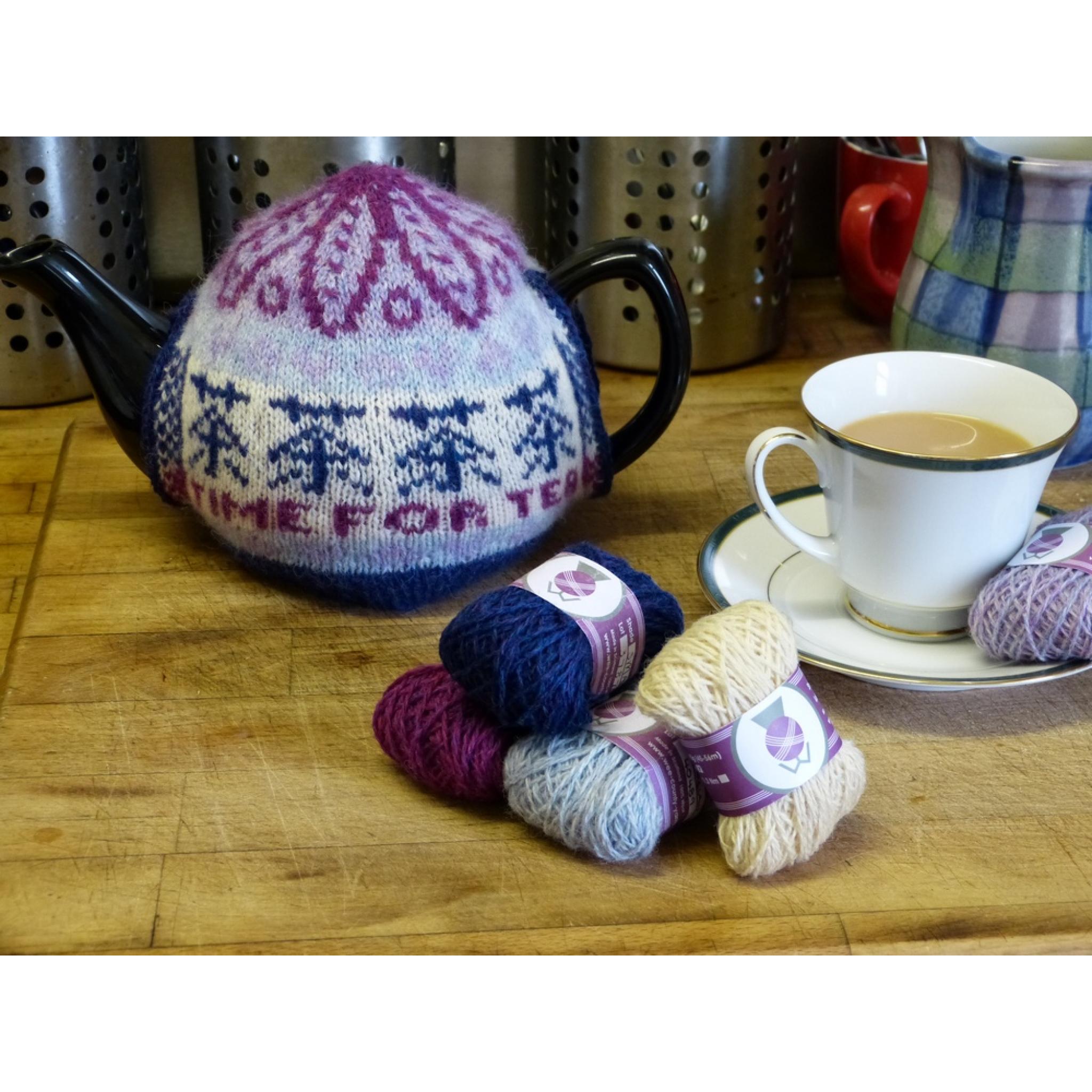
What makes this pattern different:
This is one of the most technically distinctive tea cosies in the collection because the handle and spout openings aren’t created while knitting the body at all.
Instead, extra steek stitches are incorporated into the colourwork and the cosy is worked continuously in the round. Once the knitting is complete, the designer recommends washing the cosy before cutting it, helping the wool fibres grip together and making the steek more secure.
The steek is then reinforced using crochet. A row of crochet stitches is worked up one side and down the other before the knitting is cut through the centre of the steek stitches to create the opening.
That construction has an important advantage for Fair Isle: the knitter can continue working the stranded pattern from right to left around every round rather than having to work the colourwork back and forth.
It also makes this a particularly interesting first steeking project for someone who already understands stranded knitting but hasn’t yet tried cutting their knitting. The project is much smaller than a Fair Isle cardigan or jumper, while still demonstrating the basic process of knitting, reinforcing and cutting a steek.
Get the free Wee County Yarns Fair Isle Tea Cosy PDF
Cascade 220 Superwash Sport Fair Isle Tea Cozy
Designed by Linda Voss Plummer, the Cascade 220 Superwash Sport Fair Isle Tea Cozy is a colourful in-the-round cosy that offers a relatively straightforward introduction to stranded colourwork.
The pattern uses three to five colours, which can be changed at random intervals as the cosy grows. The finished cosy measures approximately 20in / 51cm in circumference and 8in / 20cm tall, and the cast-on can be increased in multiples of five to accommodate a larger teapot.
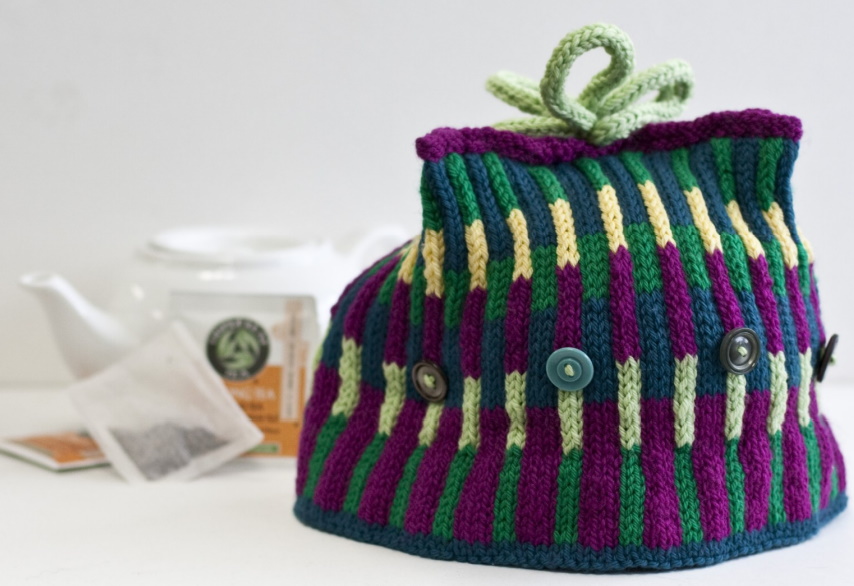
Pattern details
- Designer: Linda Voss Plummer
- Free: Yes
- Format: Free downloadable PDF
- Teapot size: Not stated by cup capacity
- Finished circumference: 20in / approximately 51cm
- Finished height: 8in / approximately 20cm
- Adjustable sizing: Can be enlarged by increasing the cast-on in multiples of 5 stitches
- Yarn: Cascade 220 Superwash Sport or Cascade 220 Worsted
- Yarn weight: Sport or worsted
- Colours: 3–5 colours
- Needles: 16in circular needles – sizes US 7 and 8 for the sport-weight version or US 8 and 9 for the worsted version
- Additional needles: DPNs for the I-cord
- Construction: Worked in the round as a tube
- Colourwork: Simple repeating stranded Fair Isle sequence of K3 in one colour and K2 in another, with colours changed at varying intervals
- Techniques: Knitting in the round, stranded colourwork, changing colours, purl turning rows, I-cord, seaming and hemming
- Lower edge: Folded hem
- Top construction: The upper edge is divided into thirds and sewn into a three-cornered shape
- Top decoration: 30in / 76cm double-strand I-cord arranged into five loops to form a flower-like top-knot handle
- Finishing: Moderate – includes a folded hem, shaped/sewn top and long decorative I-cord
- Difficulty: Not stated in the supplied pattern
- Best for: Simple Fair Isle, knitting in the round, colourful stash combinations and knitters wanting stranded colourwork without steeking or a complicated motif chart.
What makes this pattern different:
This is one of the more approachable in-the-round colourwork constructions in the collection. Instead of following an intricate Fair Isle motif chart, the colourwork follows a simple five-stitch sequence: three stitches in one colour followed by two in another. The colours can then be changed at random intervals.
Sizing is also unusually adaptable. The standard finished circumference is approximately 20in / 51cm, but the designer specifically states that the cosy can be made larger by adding stitches in multiples of five. That’s particularly useful when the reader knows the circumference of their teapot rather than its cup capacity.
The finishing creates two other distinctive features. A purl round provides a turning line so the lower edge can be folded and hemmed to give the base more substance, while the top of the knitted tube is divided into thirds and sewn into a three-cornered shape.
A long double-strand I-cord is then arranged into five loops to create the decorative top-knot handle.
Get the free Cascade 220 Superwash Sport Fair Isle Tea Cozy PDF
Two Very Different Pleated Tea Cosies
The Patons Classic Pleated Tea Cozy and Patons Beehive Tea Cozy both produce deeply dimensional folded fabric, but they achieve it in completely different ways.
Classic Pleated deliberately keeps its stranded floats shorter than usual. Those tight floats draw the fabric together and create the pleats.
Beehive physically joins different levels of the knitted fabric. A loop from a previously marked row is picked up and knitted together with the current stitch, creating a structural fold.
This is a good example of why looking at construction is more informative than simply categorising both designs as “pleated tea cosies.”
Animal and Novelty Tea Cosy Knitting Patterns
Novelty tea cosies can look complicated while having surprisingly simple main bodies.
Oliver Cat, for example, has a straightforward garter-stitch body knitted flat. Most of its character comes from the separately knitted and stuffed head, ears, paws and I-cord tail.
Alfie the Spoodle follows a similar principle, using doubled yarn to create a thick garter-stitch body before the head, ears, paws and tail are added.
The cupcake patterns demonstrate two very different approaches.
Fairy Cake Tea Cosy is knitted flat on straight needles and gets much of its appearance from a separately knitted icing layer.
I Love You Cup-Cake Tea Cozy uses DPNs and circular construction and adds a genuinely three-dimensional knitted cupcake complete with icing and cherry.
The Patons Beehive Tea Cozy creates its novelty shape through the structure of the knitting itself rather than relying on a large number of sewn-on decorations.
The Bodum Tea Cozy is included for a different reason: its unusual construction is dictated by the shape of a modern Bodum teapot rather than by decoration.
Oliver Cat Tea Cosy
The Oliver Cat Tea Cosy turns a straightforward garter-stitch cosy into a three-dimensional cat, complete with a stuffed head, paws, ears and an I-cord tail.
The main body is knitted flat as two pieces using two strands of 8-ply yarn held together. The designer suggests using yarn from your stash rather than worrying about matching a particular yarn exactly, making this an especially practical novelty pattern for using leftovers.
When laid flat, the finished cosy measures approximately 20cm wide × 15cm high and is designed to fit a 1-litre teapot.
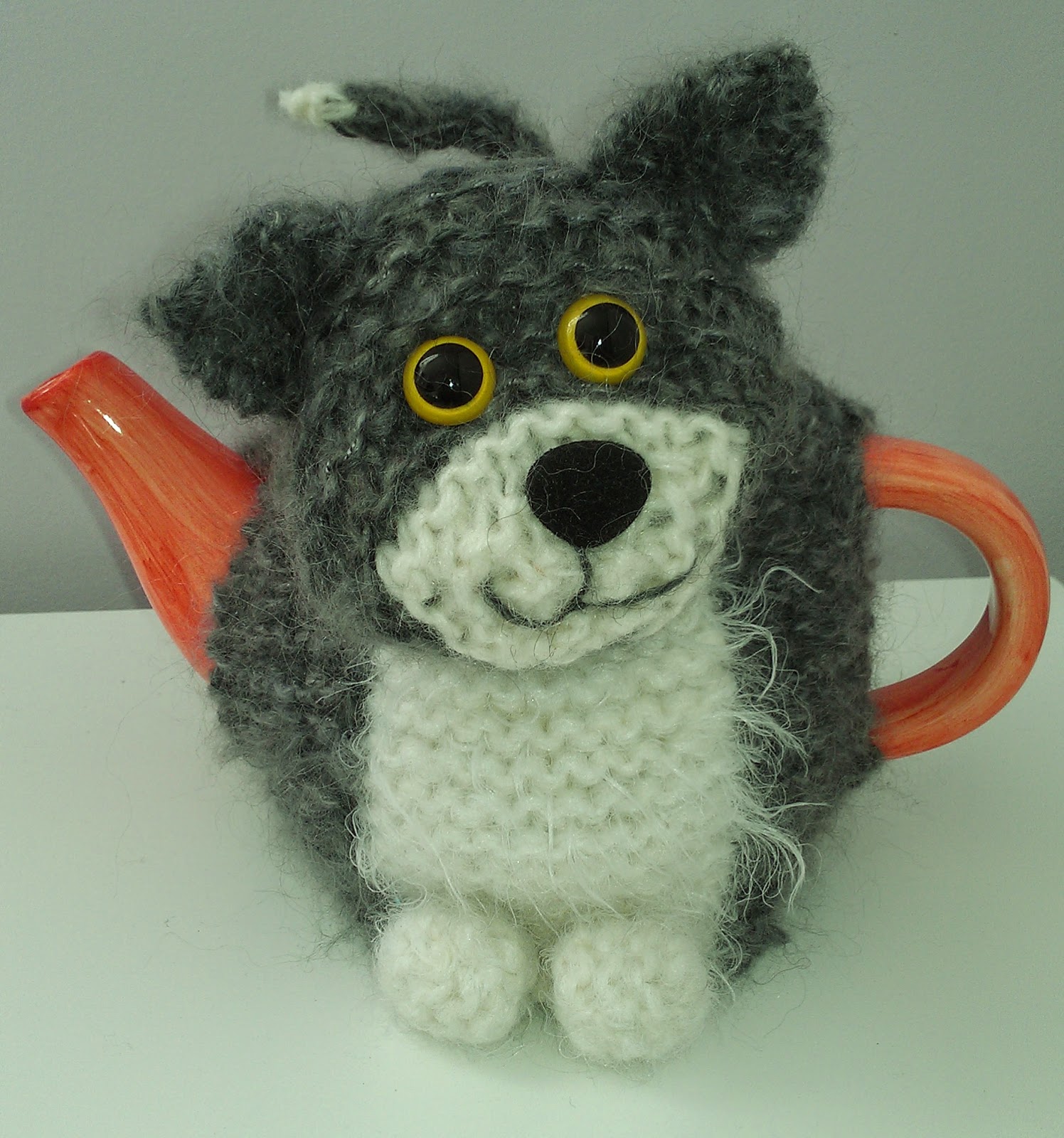
Pattern details
- Free: Yes
- Format: Free webpage pattern
- Teapot size: 1-litre teapot
- Finished size: Approximately 20cm wide × 15cm high when laid flat
- Yarn: Two strands of 8-ply yarn held together; the designer used a combination including mohair and slightly fluffy 8-ply
- Yarn weight: 8-ply / DK held double
- Main needles: 6mm straight knitting needles
- Detail needles: 4mm straight needles
- Additional needles: 4mm double-pointed needles for the I-cord tail
- Construction: Main cosy knitted flat as two pieces and seamed, leaving openings for the teapot handle and spout
- Main stitch: Garter stitch
- Techniques: Knit, k2tog decreases, simple colour changes, seaming, gathering, stuffing, embroidery and I-cord
- Cat details: Separately knitted and stuffed head, two ears, paws and an I-cord tail
- Additional materials: Toy eyes, nose and fibre-fill
- Finishing: High – although the main cosy is simple, the cat requires a separately constructed head, facial features, ears, paws and tail, followed by considerable assembly
- Difficulty: Not stated
- Best for: 1-litre teapots, cat lovers, garter-stitch knitters, novelty tea cosies and using DK/8-ply yarn from your stash.
What makes this pattern different:
The actual tea cosy body is surprisingly simple. It’s predominantly garter stitch worked on straight needles, with straightforward decreases forming the top. Most of the character comes from the separately knitted pieces and finishing rather than complicated knitting in the main cosy.
The front also uses separate grey and white sections to create the cat’s markings, with the yarns crossed at each colour change to keep the sections joined.
The three-dimensional construction is where this pattern becomes more involved. The head is knitted separately, stuffed and shaped, while the paws are gathered into small padded forms. The tail provides an opportunity to practise I-cord on double-pointed needles.
Because the pattern uses two strands of 8-ply held together, it’s also another useful example of creating a thicker tea cosy fabric without buying a dedicated chunky yarn.
Get the free Oliver Cat Tea Cosy pattern
Patons Beehive Tea Cozy
The Patons Beehive Tea Cozy uses a clever knitted pleating technique to create the deep horizontal ridges of a traditional beehive. Worked in chunky wool on straight needles, it is designed to fit a 6–8 cup teapot and measures approximately 21.5 × 23cm.
The front and back are knitted separately in stocking stitch. At intervals, stitches from an earlier marked row are picked up and knitted together with the stitches on the needle. This pulls the fabric together to form the distinctive raised pleats.
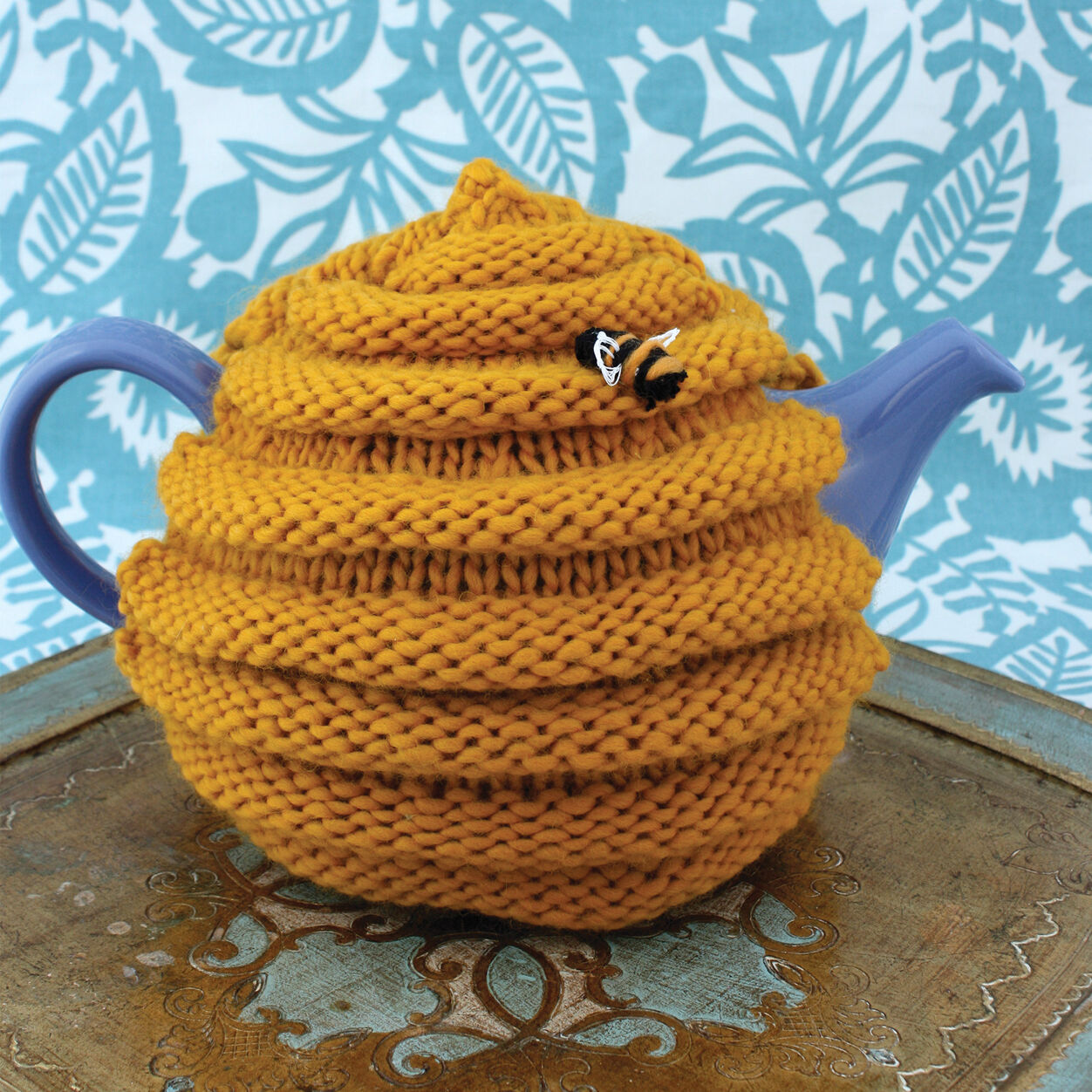
Pattern details
- Difficulty: Intermediate
- Free: Yes
- Format: Free downloadable PDF
- Teapot size: 6–8 cup
- Finished size: Approximately 21.5 × 23cm / 8½ × 9in
- Yarn: Patons Classic Wool Roving
- Yarn weight: Bulky / chunky
- Fibre: Wool
- Needles: 6mm (US 10) straight knitting needles
- Construction: Two matching pieces knitted flat and seamed
- Main fabric: Stocking stitch with knitted horizontal pleats
- Techniques: Knit, purl, k2tog, p2tog, slipped stitches, psso, decreasing, picking up loops from earlier rows to form pleats, shaping and seaming
- Gauge: 15 stitches and 20 rows = 10cm / 4in in stocking stitch
- Handle and spout openings: Approximately 11.5cm / 4½in on each side
- Decoration: Optional handmade bee appliqué
- Finishing: Moderate – two sides are seamed together, with care taken to sew through all thicknesses while allowing the pleats to lie flat
- Best for: 6–8 cup teapots, traditional tea cosies, wool cosies and knitters wanting to try an unusual pleating technique.
What makes this pattern different:
The beehive texture isn’t created with ordinary ribbing or a conventional raised stitch pattern. Instead, the knitter reaches back to a previously marked row, picks up a horizontal loop and knits it together with the current stitch. This joins two levels of the fabric and pulls the knitting into a permanent horizontal pleat.
Those repeated folds give the finished cosy considerably more depth than plain stocking stitch and are also what create its characteristic beehive shape.
It’s an interesting contrast to the Patons Classic Pleated Tea Cozy. Both use pleats, but they create them in completely different ways: the Classic Pleated Cosy deliberately shortens stranded-colourwork floats to draw the fabric into pleats, while the Beehive Cosy physically joins the current row to an earlier row to create each fold.
The optional bee is also unusual. Rather than being knitted, its body is made by wrapping black and gold yarn around a tiny piece of cardboard, with thread loops forming the wings.
Get the free Patons Beehive Tea Cozy PDF
Traditional Tea Cosy Knitting Patterns
Traditional tea cosies tend to emphasise thick fabric, ribbing, pleats, gathering and practical coverage rather than elaborate three-dimensional decoration.
However, “traditional” doesn’t mean that they’re all constructed in the same way.
The Classic Pleated Tea Cozy uses tight stranded floats to produce folds. The Beehive Tea Cozy creates physical knitted pleats. Other traditional cosies use ribbing or gathered tops to create enough stretch and volume to fit around the pot.
Ribbing is particularly useful in tea cosies because it creates elastic fabric that can accommodate some variation in teapot shape. If you want to experiment with this type of fabric, see the Knitting Bee Rib Stitch collection.
I Love You Cup-Cake Tea Cozy
Claire Garland’s I Love You Cup-Cake Tea Cozy is a chunky ribbed tea cosy topped with a three-dimensional cupcake, complete with icing and a knitted cherry. Small padded knitted hearts can also be added as decorations.
The main cosy is worked on double-pointed needles. It begins in the round, is divided so the two sides can be worked separately around the handle and spout openings, and is then joined to continue knitting in the round through the shaped crown.
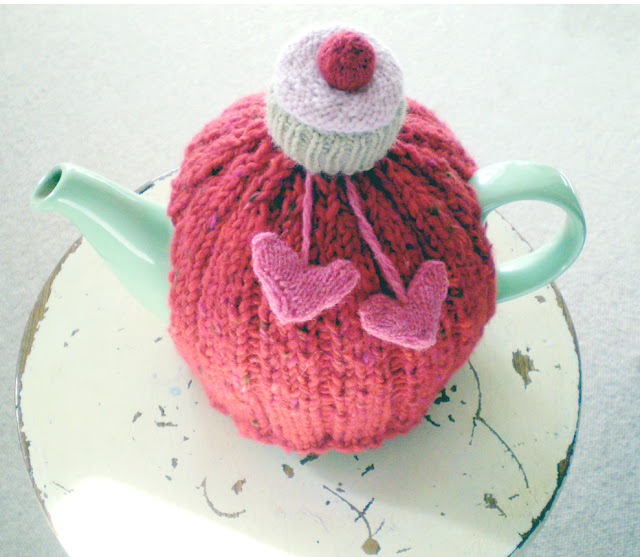
Pattern details
- Free: Yes
- Format: Free webpage pattern
- Teapot size: Not stated in the supplied pattern
- Main yarn: Chunky / bulky yarn; the original uses Debbie Bliss Donegal Luxury Tweed Chunky
- Cupcake yarn: DK / light-worsted yarn in two colours
- Cherry and hearts: 4-ply yarn
- Main needles: 5mm (US 8) double-pointed needles
- Cupcake needles: 3mm (US 2) double-pointed needles
- Main construction: Worked predominantly in the round on DPNs
- Handle and spout construction: The round is divided and the two sides worked flat separately before being rejoined
- Main stitch pattern: K3, P1 rib
- Techniques: Knitting in the round, ribbing, dividing and rejoining the round, backward-loop cast-on, k2tog, p2tog, slipped stitches, increases, decreases, kfb, I-cord-style knitting, stuffing and assembly
- Gauge: 14 stitches and 21 rows = 10cm / 4in in the rib pattern using 5mm needles
- Top decoration: Three-dimensional knitted cupcake with separate cake, icing and cherry
- Additional decoration: Padded knitted hearts
- Finishing: Moderate to high – the cosy itself requires relatively little seaming, but the cupcake, cherry and hearts are separately constructed, stuffed and assembled
- Difficulty: Not stated
- Best for: Knitters comfortable with DPNs, knitting in the round, novelty tea cosies and anyone wanting a project with three-dimensional knitted embellishments.
What makes this pattern different:
Unlike the many tea cosy patterns that begin with two flat pieces, the main cosy starts as a 64-stitch round worked across three double-pointed needles.
When the knitting reaches the teapot’s handle and spout, stitches are bound off and the two halves are worked back and forth separately. New stitches are then cast on using the backward-loop method and the two sections are rejoined, allowing the upper cosy and crown to continue seamlessly in the round.
The cupcake is almost a miniature knitting project of its own. Its base begins flat from a single stitch before expanding and being transferred to DPNs, while the icing is knitted separately and sewn into position. A tiny stuffed knitted cherry completes the top.
The optional heart is similarly three-dimensional, with increases forming the lower heart and the stitches later divided to shape its two upper curves before it is lightly padded.
Get the free I Love You Cup-Cake Tea Cozy pattern
Fairy Cake Tea Cosy
Frankie Brown’s Fairy Cake Tea Cosy is a novelty tea cosy designed to resemble a cupcake, with a ribbed “cake case,” a stocking-stitch cake section and a separately knitted icing layer that drapes over the top.
The pattern includes two sizes, one for a standard 3-cup teapot and one for a 6-cup teapot, making it more practical than novelty designs that provide only one fit.
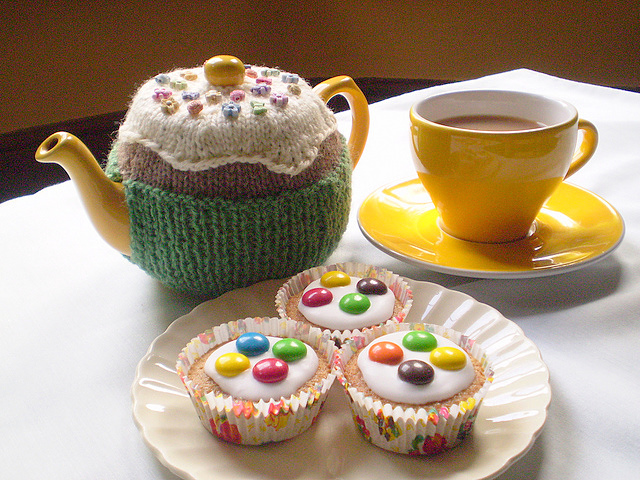
Pattern details
- Free: Yes
- Format: Free pattern available via Ravelry
- Teapot sizes: 3 cup and 6 cup
- Yarn: Double knitting / DK in three colours
- Needles: 3.25mm (US 3) and 4mm (US 6) straight knitting needles
- Construction: Main cosy knitted flat as two matching halves and seamed around the handle and spout
- Main stitches: K1, P1 rib and stocking stitch
- Icing: Separately knitted shaped piece sewn over the top of the cosy
- Techniques: Knit, purl, k2tog, M1 increases, ribbing, stocking stitch, shaping and seaming
- Gauge: Approximately 11 stitches and 18 rows = 5cm / 2in square in stocking stitch on 4mm needles
- Decoration: Optional buttons or beads
- Finishing: Moderate – two main sections are seamed together, the icing is seamed separately and then pinned and sewn to the cosy
- Difficulty: Not stated in the supplied pattern
- Best for: 3- or 6-cup teapots, straight-needle knitters, novelty tea cosies and knitters wanting a decorative result without complicated colourwork or circular knitting.
What makes this pattern different:
The visual effect comes from layered construction rather than difficult stitchwork. The lower ribbing forms the ridged paper cake case, the stocking-stitch section represents the cake, and the icing is knitted separately before being fitted over the top.
The icing itself is shaped through repeated decreases, with an early increase-and-decrease row creating the scalloped effect. Because it is made separately, the knitter can position it over the completed cosy before sewing it permanently into place.
The two sizes are also useful. Many novelty tea cosies give only one approximate fit, while this pattern supplies separate stitch counts and shaping instructions for standard 3-cup and 6-cup teapots.
Get the Fairy Cake Tea Cosy pattern on Ravelry
Blighty Teacosy & Egg Cosy
Designed by Emma Varnam, the Blighty Teacosy is a striped red, navy and neutral tea cosy designed to fit a 6–8 cup teapot. The pattern also includes a matching miniature egg cosy.
Rather than making two separate sides, the main tea cosy begins with 116 stitches worked as one wide flat piece. The knitting is later divided to form an opening, worked in separate sections and then brought back together before the crown is shaped.
Pattern details
- Designer: Emma Varnam
- Free: Yes
- Format: Free downloadable PDF
- Teapot size: 6–8 cup
- Yarn: Millamia Naturally Soft Merino
- Fibre: 100% extrafine merino wool
- Yarn weight: DK
- Needles: 4mm straight knitting needles
- Additional needles: Two 4mm double-pointed needles for the I-cord decoration
- Construction: Main cosy worked flat as one wide piece, temporarily divided into two sections and later rejoined
- Main stitch pattern: Alternating knit rows with a repeating “knit into stitch below, P2” row
- Colourwork: Broad horizontal stripes in three colours
- Techniques: Knit, purl, knitting into the stitch below, changing colours, dividing stitches, working separate sections, rejoining stitches, k2tog shaping, seaming and I-cord
- Gauge: 24 stitches and 22 rows = 10cm / 4in in pattern on 4mm needles
- Crown shaping: Successive k2tog decrease rows reduce 106 stitches to 53, 27, 14 and finally 7
- Top decoration: 30cm / 12in I-cord formed into three loops with a decorative button
- Finishing: Moderate – one main side seam, ends to weave in and a separate I-cord decoration
- Extra: Pattern includes a matching striped egg cosy topped with a pom-pom
- Difficulty: Not stated in the supplied pattern
- Best for: 6–8 cup teapots, DK yarn, textured knitting, horizontal stripes and knitters wanting to try a knit-below stitch pattern.
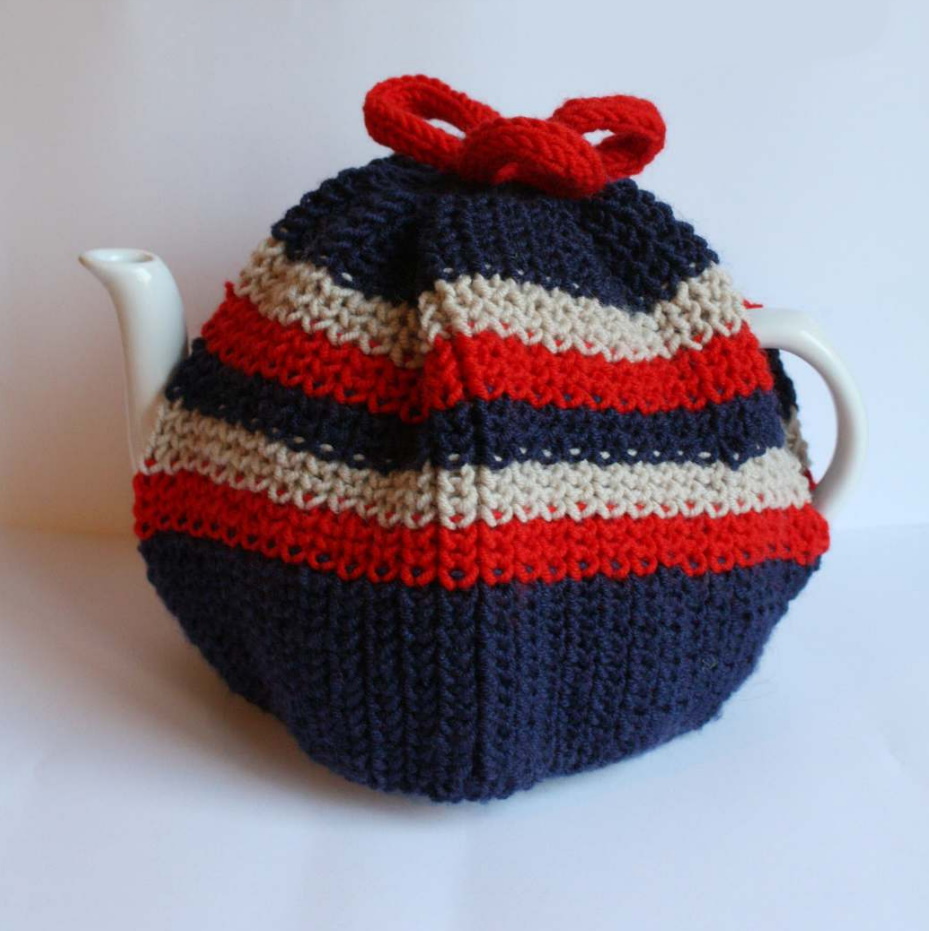
What makes this pattern different:
The texture is the most interesting feature of Blighty. Every second row combines knitting into the stitch below with P2, rather than relying on ordinary stocking stitch or ribbing. This produces a more pronounced textured fabric while still using a relatively simple repeating pattern.
Its construction is unusual too. The cosy begins with 116 stitches across one piece, rather than making separate front and back sections. After the lower section is knitted, 53 stitches are worked separately on either side of a 10-stitch opening. The sections are later brought back together so the upper cosy can once again be worked as a single piece.
That makes Blighty useful in our construction comparison: it is predominantly flat knitting on ordinary 4mm needles, despite having a more unusual divided-and-rejoined structure. The DPNs are only required to make the decorative I-cord at the top.
The matching egg cosy is another useful extra. It repeats the same knit-below texture and colour sequence on a much smaller scale, finishing with a pom-pom rather than the looped I-cord used on the teapot cosy.
Get the free Blighty Teacosy & Egg Cosy PDF
Which Tea Cosy Patterns Have Extra Insulation?
All tea cosies are intended to help reduce heat loss, but the patterns in this collection use very different approaches to creating thickness.
I haven’t temperature-tested these cosies, so I wouldn’t claim that one is definitively the warmest. What we can compare is the physical construction specified by each pattern.
| Tea cosy | How additional thickness is created |
|---|---|
| Cottage Tea Cosy | 100% wool knitted shell plus wadding and a separate fabric lining |
| Daisy Bush | Complete knitted outer cosy plus a separate knitted inner layer |
| Rosie Posie | One continuous knitted piece folds back into itself to form a double layer |
| Tea Rose | Separately knitted outer and lining sections |
| Union Jack | Separate knitted outer and knitted inner pieces |
| Rosebuds | Bulky wool deliberately knitted on smaller needles to create a thicker fabric |
| Classic Pleated | Wool fabric is pulled into substantial pleats by deliberately short stranded floats |
| Alfie the Spoodle | Two strands are worked together; the designer specifically describes the resulting fabric as firm and thick |
| Cascade Fair Isle | Lower section incorporates a folded hem, which the designer says adds substance |
The Cottage Tea Cosy is particularly unusual because it combines three distinct components: knitted wool, wadding and fabric lining.
Daisy Bush is notable for a different reason. Its designer explicitly describes the double-layer cosies as being designed to keep the teapot seriously warm.
If keeping tea hot is your priority, these construction details are more useful than choosing a pattern purely because the finished cosy looks thick.
Flat vs In-the-Round Tea Cosy Patterns
There isn’t one correct way to construct a knitted tea cosy.
Knitting a Tea Cosy Flat
The most straightforward construction is generally two matching pieces knitted on straight needles.
After knitting, the pieces are sewn together above and below the handle and spout, leaving openings between the seams.
This method appears in many of the patterns in this collection and is a good choice if you prefer straight needles.
Knitting a Tea Cosy in the Round
Circular construction reduces seaming but creates another problem: the handle and spout interrupt the tube.
Different designers solve this differently.
Seeded Columns begins in the round, separates into flat sections for the opening and later rejoins in the round.
I Love You Cup-Cake similarly works circularly, divides into flat sections around the handle and spout, then reconnects the knitting.
The Wee County Fair Isle cosy takes the most dramatic approach: the colourwork is knitted as a tube and openings are subsequently created by steeking.
Hybrid Construction
Some of my favourite patterns from a construction point of view use both methods.
The Flower Tea Cosy by Sachiyo Ishii starts with a separately knitted front and back before the pieces are joined onto DPNs and the crown is completed in the round.
Cosy Cables also begins with separate flat sections and then joins the live stitches for circular crown shaping.
These hybrid constructions are worth considering if you are comfortable on straight needles and want a relatively small introduction to knitting in the round.
Tea Cosy Knitting Techniques: From Basic to More Involved
There is no perfect difficulty ranking because designers don’t use a universal difficulty scale. I’ve therefore kept official difficulty ratings only where the original pattern provides them.
However, the techniques themselves give us a useful progression.
1. Garter stitch and simple seaming
Start with a pattern such as the Lily Sugar’n Cream Beginner Tea Cozy. If you can cast on, knit, cast off and sew a seam, you have most of the skills required.
2. Stocking stitch and ribbing
The next step introduces knit-and-purl combinations and simple shaping.
You can practise different combinations in the Knitting Stitch Library.
3. Basic decreases and crown shaping
Many cosies use k2tog, p2tog or similar decreases to narrow the fabric over the top of the teapot.
4. Textured stitches
Smocking, twisted stitches, knit-below techniques and slip stitches create more interesting surfaces without necessarily requiring circular knitting.
5. Cables
Start with a small twisted or cable detail before progressing to Cosy Cables, Sheryl’s Tea Cozy or the much more involved Aran Sweater Tea Cozy.
See more free cable knitting stitches if you want to practise the technique first.
6. Stranded colourwork
Simple repeating stranded patterns are a good introduction before more detailed Fair Isle charts.
7. Circular and hybrid construction
Working in the round and learning how to divide the knitting for handle and spout openings adds another construction skill.
8. Steeking
The Wee County Fair Isle Tea Cosy includes reinforced steeks that are cut after the colourwork has been knitted.
9. Two-colour brioche
Brewed in Brioche sits at the technical end of this particular collection. It is officially rated Advanced and combines two-colour brioche worked flat and in the round with specialised brioche decreases.
Importantly, technical difficulty isn’t the same as finishing workload.
Brewed in Brioche requires considerably more specialised knitting knowledge than Rosebuds, for example, but Rosebuds requires the knitter to make and assemble 15 rosebuds and 10 sets of leaves after knitting the body.
What Yarn Is Best for a Tea Cosy?
There isn’t one yarn weight used across tea cosy patterns.
The patterns I’ve compared range from finer yarns used for colourwork through DK and worsted to bulky and super-bulky yarns.
Wool is a common choice, particularly in traditional designs, but several patterns use cotton and others use acrylic or blended yarns.
Rather than automatically substituting yarn based on fibre or weight alone, check the gauge and finished measurements of the pattern. This is particularly important for tea cosies because the handle and spout openings need to sit in approximately the right place on the pot.
Can I Use Leftover Yarn for a Tea Cosy?
Often, yes.
Tea cosies are relatively small projects, and patterns involving stripes, flowers, leaves, Fair Isle or other small colour details can be particularly useful for using smaller quantities of yarn.
However, check the pattern requirements before substituting. A small amount of yarn may be sufficient for flowers or contrast stripes but not necessarily for the main body.
What I Learned Comparing 30+ Free Tea Cosy Knitting Patterns
After comparing the sizing, materials, construction and techniques used across these free tea cosy patterns, several things stood out.
Teapot capacity isn’t a reliable measurement on its own. Two 6-cup pots can have very different proportions. Finished circumference and height are more useful when the designer supplies them.
Straight needles are still extremely common. You don’t need to know how to knit in the round to have a large choice of tea cosy patterns.
There are many ways to deal with the handle and spout. Some patterns simply leave gaps in the side seams. Others divide the knitting, create buttonhole-like openings, use plackets or even cut steeks.
A complicated-looking cosy isn’t necessarily difficult to knit. Floral and animal cosies often have straightforward bodies but considerable finishing.
Conversely, a simple-looking cosy can require advanced techniques. Brioche, Fair Isle and steeking can produce relatively restrained designs while requiring considerably more technical knitting.
Lining is not standard. Most knitted tea cosies consist of a single knitted shell, but a smaller group use double knitted layers, separate linings or wadding.
Designers create pleats in completely different ways. Comparing Classic Pleated with Beehive is a particularly good example: one manipulates stranded floats while the other physically connects different rows of knitting.
This is why I’ve included construction, sizing, needle type and finishing information throughout the collection wherever it could be verified from the original pattern.
If you enjoy using small projects to learn new stitches, you can find hundreds more free techniques in the Knitting Bee Knitting Stitch Library.
Frequently Asked Questions About Knitting Tea Cosies
The Lily Sugar’n Cream Beginner Tea Cozy is one of the simplest patterns in this collection. It is officially rated Beginner and consists of two garter-stitch squares sewn together and gathered at the top. There is no purling, circular knitting or knitted shaping in the main pieces.
Yes. Many tea cosy knitting patterns are worked completely flat on straight needles. Usually a front and back are knitted separately and then sewn together, leaving openings for the handle and spout.
Some patterns described as flat may still use DPNs for a small detail such as I-cord, so check the needle information if you specifically want to avoid circular or double-pointed needles.
Measure your teapot around its widest point and check its height from the base towards the lid. Compare those measurements with the pattern whenever finished dimensions are supplied.
Cup capacity is useful, but it shouldn’t be your only measurement because teapots of the same capacity can have very different shapes.
Choose a pattern specifically designed for six cups or compare the pattern’s finished measurements with your pot. Options in this collection include the Lily Sugar’n Cream Tea Cozy and Egg Cozy and Flower Basket Tea Cozy, while several other patterns cover a broader 6–8 cup range.
Use the yarn weight recommended by the pattern wherever possible, particularly if fit is important. Wool, cotton, acrylic and blends all appear in the patterns in this collection.
If substituting yarn, make a gauge swatch and check the finished measurements rather than assuming all yarns labelled DK or worsted will produce the same-sized cosy.
No. Many traditional tea cosy patterns consist only of knitted fabric. However, some designs deliberately add another layer. The examples in this collection include separate knitted linings, integrated double-layer construction and, in the Cottage Tea Cosy, wadding and a fabric lining.
A second layer creates more material between the teapot and surrounding air, but I haven’t independently tested the patterns in this collection for heat retention.
If insulation is important to you, compare the construction rather than relying on appearance alone.
In a basic flat cosy, the front and back are usually sewn together at the top and bottom of each side while an unsewn section is left for the handle or spout.
Circular patterns require different solutions. Depending on the design, the knitting may be divided and worked flat temporarily, stitches may be cast off and cast on again, or steeks may be used.
For a beginner who already uses straight needles, a two-piece flat tea cosy is generally the more straightforward construction because it avoids circular knitting.
Once you’re comfortable knitting in the round, however, circular construction can reduce the amount of seaming required.
They can be. Small tea cosies, stripes, Fair Isle motifs and separately made flowers and leaves can all use relatively modest quantities of yarn. Always check the pattern’s stated yarn requirements before starting.
Browse the Knitting Bee Knitting Stitch Library for hundreds of free stitch patterns, including cable knitting stitches, rib stitches and slip stitch patterns.