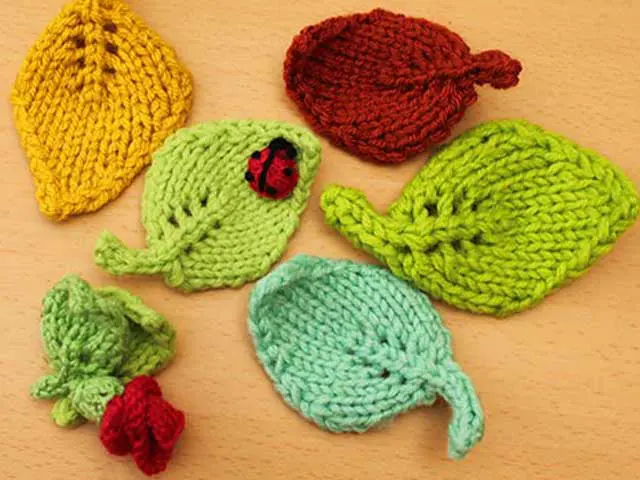
This sweet knitted leaf pattern is one of those tiny projects worth keeping bookmarked because you can make it again and again with whatever yarn you have available. Designed by Sachiyo Ishii for Clover, the leaf begins with a little knitted i-cord stem before increasing out into the leaf shape and tapering neatly back to a point.
Better still, the pattern isn’t tied to one particular yarn: use fine yarn for delicate little leaves or aran and chunky yarn for larger, more substantial motifs. It’s a particularly useful scrap-yarn project when you have small amounts of green, autumnal or leftover yarn that aren’t enough for a larger knit.
- Yarn weight: Any yarn weight
- Needle size: Choose to suit your yarn; sample leaf uses 4.5 mm needles
- Skill level: Easy
- Finished size: Variable depending on yarn, needles and number of increases
- Knit flat or in the round: Mostly knit flat, with an i-cord stem
- Techniques: I-cord, increases, decreases, yarn forward
- Designer: Sachiyo Ishii
- Get the free pattern: Get the free knitted leaf pattern
🧶 Yarn pick: This is a perfect pattern for using leftover yarn because each leaf requires only a small amount. DK or 4-ply yarn will produce smaller, more delicate leaves, while aran or chunky yarn creates a much bolder leaf. Try several weights from your stash and make a collection of different-sized leaves rather than buying yarn specifically for this project.
Materials Used in This Pattern
- Yarn: A small amount of yarn of your choice
- Sample aran yarn: 100% acrylic, approximately 150 m per 100 g
- Sample chunky yarn: Approximately 130 m per 100 g
- Needles: 4.5 mm double-pointed knitting needles for the featured leaf
- Finishing: Yarn needle for weaving in ends
- Optional: Protective pressing cloth for lightly steam pressing the finished motif
What You Need to Know Before Knitting
This little leaf is more interesting to knit than its finished size might suggest.
The stem begins as an i-cord, so if you’ve never knitted i-cord before, this is a very manageable project for learning the technique. The leaf itself is shaped by increasing around the centre and then decreasing towards the tip.
You’ll encounter several basic knitting techniques including knit and purl stitches, yarn forwards, knitting two stitches together and a slipped-stitch decrease.
The result is a defined symmetrical leaf rather than simply an oval piece of knitting.
Make Your Knitted Leaves Bigger or Smaller
One of the best features of this pattern is how easily you can alter its size.
The designer specifically suggests changing the yarn weight to change the scale of the finished leaf. Try 4-ply or DK yarn for small delicate leaves and aran or chunky yarn for larger, thicker leaves.
You aren’t restricted to the original number of increases either. For a bigger leaf, continue increasing on either side of the centre stitch until the leaf reaches the width you want, then begin the decreases to form the point.
That makes this a useful little pattern for experimenting with both yarn weight and knitted shaping.
What Can You Do With Knitted Leaves?
Once you’ve made one, it’s easy to think of reasons to knit another.
Small knitted leaves can be added to knitted flowers, hats, bags, scarves, baby garments and handmade gifts. Make several in different greens for a botanical embellishment, or use rust, mustard, ochre, burgundy and brown yarns to create autumn leaves.
You could also make a collection for:
- knitted garlands
- wreath decorations
- gift wrapping
- brooches and pins
- flower embellishments
- table decorations
- seasonal displays
- appliqués
- scrap-yarn projects
Because you need so little yarn, they’re also an excellent way of using those last few metres left after finishing a larger project.
More Than Just a Leaf
The original Clover project also includes instructions for making a tiny knitted ladybird and knitted rose, allowing the leaves to become part of a larger decorative project.
The rose has separate knitted petals, a sepal and two small leaves, while the tiny ladybird is knitted using small amounts of red and black 4-ply yarn.
So if you enjoy the basic leaf, it’s worth looking through the complete project sheet rather than stopping after the first motif.
Frequently Asked Questions
Can beginners knit this leaf?
Yes, although it is more suitable for a beginner who already knows basic knit and purl stitches. You’ll also use increases, decreases and i-cord, making the project a useful introduction to several techniques without committing to a large piece of knitting.
What yarn should I use for knitted leaves?
Almost any yarn can be used. The original project specifically allows for different yarn weights. Use 4-ply or DK for smaller leaves and aran or chunky yarn for larger leaves.
How much yarn does a knitted leaf need?
Only a small amount is required, which makes this an excellent scrap-yarn knitting project.
Can I make the knitted leaf larger?
Yes. Continue increasing on either side of the centre stitch until the leaf reaches your desired width, then work the decreases to taper it towards the point.
What needles do I need?
The featured leaf uses 4.5 mm double-pointed needles, but the designer recommends changing needle size to suit the yarn weight you choose.
Why are double-pointed needles used?
The leaf starts with a short length of i-cord. Double-pointed needles make it easy to slide the stitches from one end of the needle to the other when creating the cord without turning the work.
Do I need to block knitted leaves?
The original instructions recommend gently pressing the completed leaf flat with a steam iron while protecting the knitting with a cloth. Be careful to use a pressing method appropriate for the fibre you’ve chosen.
Where can I get the complete knitted leaf pattern?
The complete Leaf (Knitting) project by Sachiyo Ishii is available free from Clover. Follow the free pattern link near the top of this page for the original instructions and project sheet.