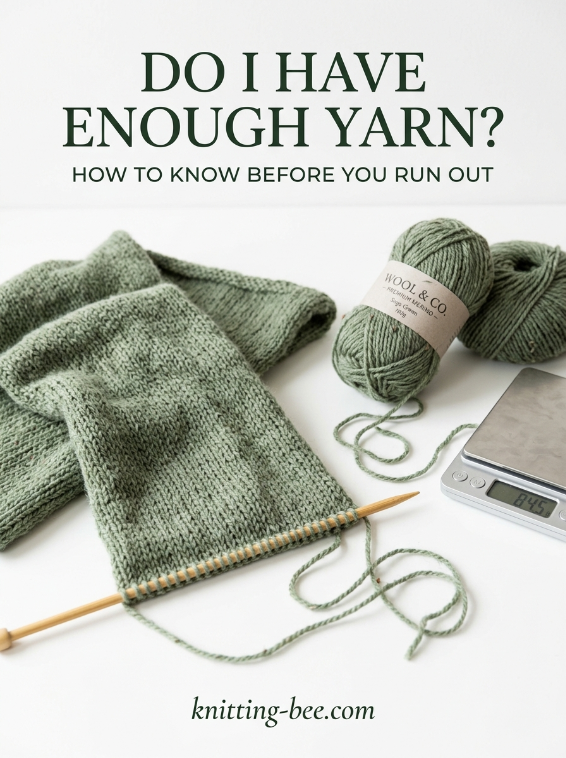
Wondering whether you have enough yarn to finish a knitting project? The most reliable method is to compare the metres or yards you have with the amount required by the pattern. If you’ve already started knitting, weighing your remaining yarn can also help you estimate how much you have left.
Don’t rely on the number of balls alone. Two 100g balls of different yarns can contain very different lengths of yarn.
- Before you start: compare total metres or yards
- Already knitting: weigh the yarn you have left
- Making a repeated section: weigh yarn before and after one repeat
- Knitting without a pattern: weigh completed sections to estimate what remains
- Close on yardage: leave yourself a safety margin
The Quickest Way to Check If You Have Enough Yarn
Start with your yarn label.
Find:
Ball weight: for example, 100g
Length: for example, 200 metres
Now check how many balls you have.
If you have four balls:
4 × 200m = 800 metres
If your knitting pattern requires 720 metres, you have more yarn than the stated requirement.
If it requires 850 metres, you don’t.
This sounds obvious, but checking length rather than simply the number or weight of balls prevents a lot of yarn problems.
Why Grams Alone Don’t Tell You Enough
Imagine you have two different 100g balls.
One contains 400 metres.
The other contains 100 metres.
They weigh exactly the same, but one gives you four times as much yarn.
This happens because finer yarn packs much more length into the same weight than thick yarn.
When determining whether you have enough yarn, metres or yards are usually the most useful measurement.
How Much Extra Yarn Should I Have?
Avoid choosing a project that requires every last metre you own.
Pattern yardage is an estimate. Your actual yarn usage can change because of:
- gauge
- tension
- modifications
- swatching
- yarn characteristics
- joining yarn
- finishing
- your chosen size
Having some additional yarn gives you room for variation.
This becomes particularly important when using discontinued yarn, hand-dyed yarn or yarn from an old stash where buying another matching ball may be impossible.
How to Estimate Leftover Yarn by Weight
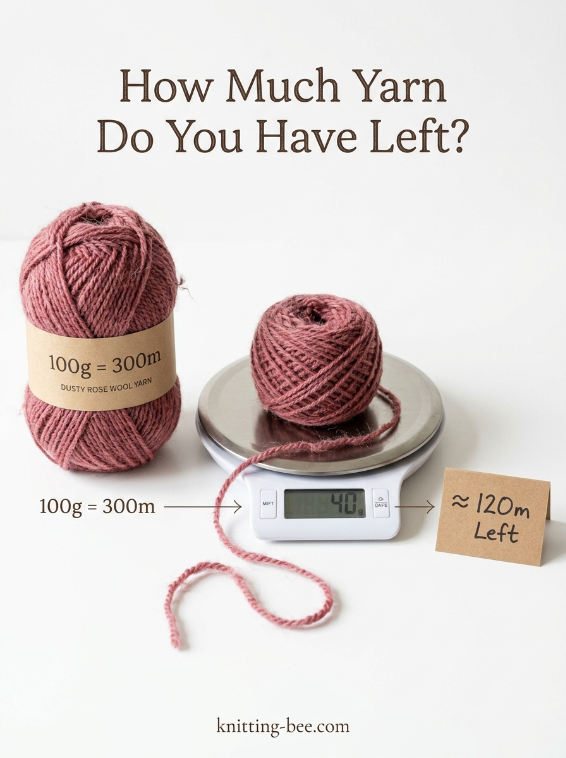
If you’ve lost the label or have already used part of the ball, a kitchen scale can be extremely useful.
Suppose your original yarn was:
100g = 300m
You weigh the remaining ball and it is 40g.
You have approximately 40% of the original yarn remaining.
300m × 0.40 = approximately 120m
It’s an estimate rather than a laboratory measurement, but it’s far more useful than looking at the ball and guessing.
How to Tell If You Have Enough Yarn When You’re Already Knitting
This is where weighing becomes particularly useful.
Imagine you’re knitting a scarf with a repeating pattern.
Weigh your yarn.
Knit 10cm.
Weigh the yarn again.
If you started with 80g and now have 72g, that section used approximately 8g.
You can now estimate how many more similar sections your remaining 72g could produce.
This technique works particularly well for projects with predictable construction.
Use the Halfway Rule for Symmetrical Projects
Some projects give you another useful checkpoint.
If you’re knitting a scarf from one end to the other and want both halves to be approximately equal, you need roughly half your available yarn remaining when you reach the midpoint.
The same principle can help when making two matching pieces.
For example, if you’re knitting two identical mitts from one ball, weigh the yarn before starting.
If the first mitt consumes more than half your available yarn, you know immediately that the second may be a problem.
How Do I Know If I Have Enough Yarn for Two Socks?
Weigh your yarn before beginning.
Then weigh the completed first sock.
If you started with 100g and the first sock weighs 42g, you should have enough to make a second comparable sock.
If your first sock used 54g, you probably won’t have enough to make an identical second sock from the remaining yarn.
This simple approach works for:
- socks
- mittens
- gloves
- sleeves
- baby booties
- other matching pairs
How Do I Know If I Have Enough Yarn for the Sleeves?
Sleeves are a classic place to discover you’re running out of yarn.
If you’re concerned, consider knitting the sleeves before completing less essential parts such as an oversized collar or decorative finishing.
For a sweater with two matching sleeves, you can also divide your remaining yarn into two equal amounts by weight.
That way, you know how much is available for each sleeve.
Another option is to alternate between sleeves, knitting a section of one and then the same section of the other.
If yarn becomes tight, both sleeves can be adjusted consistently.
What Uses More Yarn Than You Might Expect?
Some design features can increase yarn consumption.
Cables
Cable knitting creates a dense, textured fabric and can require more yarn than plain stockinette over a comparable area.
Ribbing
Deep ribbed sections can also consume substantial yarn.
Oversized Fit
A few extra centimetres across the width and length of a garment add up.
Long Sleeves
Changing a pattern from short sleeves to full-length sleeves obviously increases requirements.
Large Collars
Deep shawl collars, turtlenecks and oversized necklines can consume surprisingly large amounts of yarn.
Pompoms
That enormous fluffy pompom on top of your hat isn’t free—it can use a noticeable amount of your remaining ball.
If yarn is tight, don’t leave important structural parts until after decorative features.
What Should I Do If I’m Not Sure I Have Enough?
Prioritise the parts of the project that matter.
If you’re knitting a sweater, for example, finishing both sleeves is more important than having an oversized collar.
Possible yarn-saving adjustments include:
- shorten sleeves slightly
- shorten the body
- reduce an oversized collar
- omit pockets
- use contrast yarn for borders
- make narrower cuffs
- omit tassels or pompoms
Don’t randomly change needle size in an attempt to save yarn. Needle size affects gauge, which affects the dimensions and fit of the finished piece.
What If My Yarn Has Been Discontinued?
Be conservative.
If you can’t easily purchase another matching ball, don’t choose a pattern whose stated requirement is almost identical to the amount you own.
This is particularly important with hand-dyed yarn because even another skein of the same colorway may look noticeably different.
If you’re unsure, incorporate a coordinating second color deliberately from the beginning.
Contrast cuffs, stripes, borders and colorwork look intentional.
A completely different yarn added for the final five rows because you ran out does not always have quite the same effect.
Can I Calculate Yarn Without the Original Label?
Sometimes.
If you know exactly what yarn it is, you may be able to find the original specifications and use its metres-per-gram figure to estimate your remaining length.
If you don’t know what the yarn is, weighing it will tell you how many grams you have—but not automatically how many metres.
In that situation, treat any estimate cautiously.
The Kitchen Scale Is One of a Knitter’s Best Tools
You don’t need specialist equipment.
An ordinary digital kitchen scale capable of measuring grams can answer surprisingly useful knitting questions:
How much yarn is left?
Did the first sock use more than half?
How much yarn does one pattern repeat use?
Do I have enough for another stripe?
How should I divide my remaining yarn between two sleeves?
It turns “I think I have enough” into something you can actually estimate.
Frequently Asked Questions
How can I calculate how much yarn I have left?
If you know the original ball weight and length, weigh your remaining yarn and calculate the same proportion of the original meterage. For example, if 100g originally contained 200m and you have 25g remaining, you have approximately 50m left.
Should I calculate yarn in grams or metres?
Metres or yards are usually more useful when comparing your yarn with a knitting pattern. Grams become particularly useful when estimating how much of a known yarn you have left.
Is pattern yardage exact?
No. Pattern yardage is an estimate. Your gauge, size, modifications and knitting can affect how much yarn you actually use.
How do I divide yarn evenly for two sleeves?
Weigh your remaining yarn and divide it into two equal quantities by weight. You can then use one portion for each sleeve.
How can I tell if I have enough yarn for another pattern repeat?
Weigh your yarn before knitting one repeat and again afterwards. The difference gives you an approximate yarn weight per repeat.
Should I buy an extra ball of yarn?
If you’re close to the stated requirement and the yarn is still available, having an extra ball provides useful insurance. This is particularly worthwhile when dye-lot differences could make purchasing another matching ball later difficult.
Measure Instead of Guessing
When you’re wondering whether you have enough yarn, the answer is rarely sitting in the size of the ball.
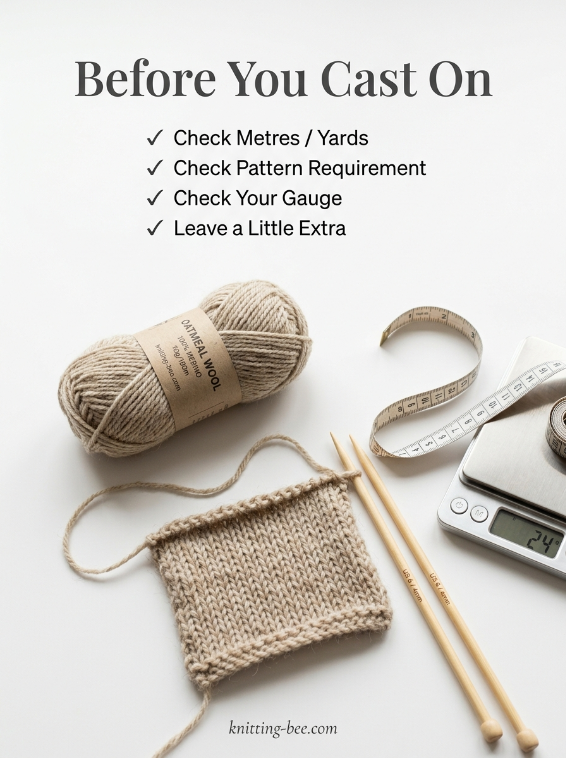
Look at the metres or yards, check the pattern requirements and use a kitchen scale once knitting is underway.
Those three pieces of information can tell you far more than simply counting how many balls you have left.
And if you discover you don’t have quite enough, don’t give up on the yarn. See our guides to What Can I Knit With 100g of Yarn?, What Can I Knit With One Skein of Yarn? and What Can I Knit With Leftover Yarn? for projects better suited to the amount you have.
Find thousands of free knitting patterns and knitting resources at knitting-bee.com.
See More Knitting Patterns & Helpful Guides
Not sure what to make with the yarn you have? Explore more free patterns, stitches and knitting ideas from Knitting Bee:
- Free Sweater Knitting Patterns
- Free Cardigan Knitting Patterns
- Free Hat Knitting Patterns
- Free Scarf Knitting Patterns
- Free Cowl Knitting Patterns
- Free Baby Knitting Patterns
- Free Baby Cardigan Knitting Patterns
- Free Knitted Toy Patterns
- Free Dishcloth Knitting Patterns
- Easy Knitting Patterns for Beginners
- Knitting Stitch Library
- Free Lace Knitting Stitches
- Free Cable Knitting Stitches
- Free Knitting Patterns